Semantic Layer: The Constraint Framework for Trustworthy AI Agents
The semantic layer is not an accelerator for AI agents—it is the foundational constraint framework enabling their trustworthy operation. This article analyzes how ontology-driven semantic modeling anchors natural language queries, access policies, and executable actions to a unified, auditable data contract.
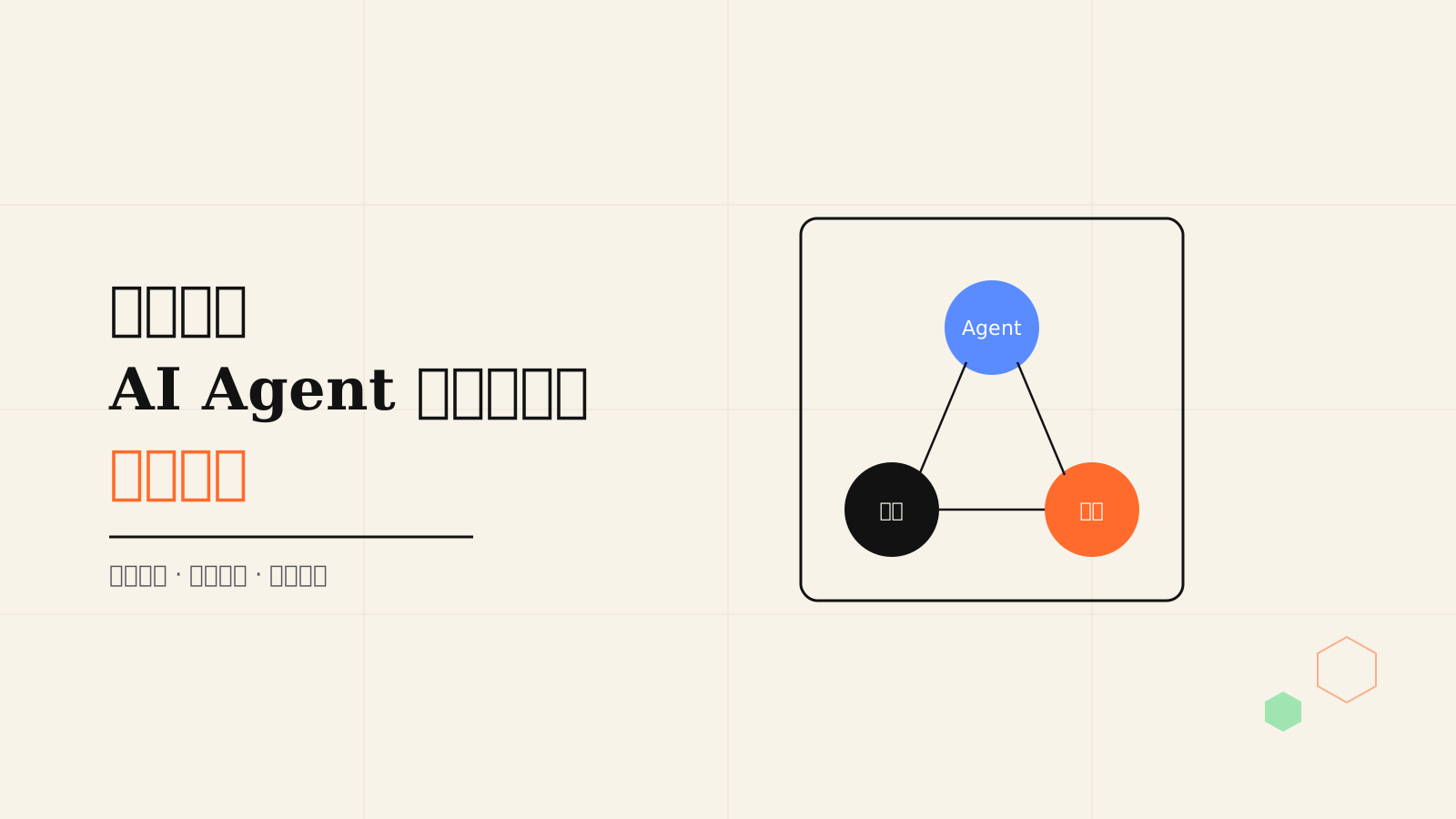
The biggest hidden cost in deploying AI agents isn’t compute or model licensing—it’s the absence of a shared data contract. When multiple agents concurrently query the same customer table, ambiguity arises immediately: if ‘active customer’ means ‘placed an order in the last 30 days’ for marketing but ‘no overdue payments in the last 90 days’ for risk control, no system can resolve this automatically. In such cases, even state-of-the-art LLMs don’t help—they amplify inconsistencies. The semantic layer’s core purpose is to establish a machine-readable, business-auditable, and policy-aware data contract—not merely to boost NL2SQL accuracy.
Semantic Layer ≠ Pre-SQL Translation Layer
A common misconception treats the semantic layer as nothing more than a ‘translator’ between natural language and SQL: ‘Q3 revenue in East China’ becomes SELECT SUM(revenue) FROM sales WHERE region = 'East China' AND quarter = 'Q3'. This view overlooks three critical fractures:
- Definition fracture: The same metric may have conflicting definitions across teams. The semantic layer must explicitly version and scope them—e.g.,
revenue@marketing_v2vs.revenue@finance_v1.
- Access fracture: Queries must inject fine-grained, context-aware access policies before hitting the database—not rely on coarse row-level filters downstream.
- Intent fracture: NL2SQL answers ‘what to retrieve’, but agentic workflows require ‘why retrieve it’ and ‘what to do next’. The semantic layer must encode operational intent—e.g.,
query_type: diagnostic,action_on_success: trigger_alert_if > threshold.
Its true value lies in inserting an auditable, versioned, composable contract verification ring between ambiguous input and deterministic execution.
Ontology Modeling: From Field Mapping to Conceptual Relationships
Traditional semantic layers often stop at field aliases and computed columns (e.g., Looker Explores). Ontology-driven modeling goes deeper—structuring business meaning hierarchically:
- Entity layer: Business objects with identity (Customer, Order, Product), decoupled from physical storage.
- Attribute layer: Properties describing entities (Customer.age, Order.status), annotated with type, business meaning, and source system.
- Relationship layer: Cross-entity constraints (
Order.customer_id → Customer.id) enabling reverse inference (e.g., ‘find high-value customers who placed orders’).
- Rule layer: Embedded business logic (
IF Order.status = 'shipped' THEN Order.shipped_at IS NOT NULL) used for runtime validation and agent decision branching.
This structure enables semantic reasoning: For a request like ‘orders shipped in the last 7 days’, the system dynamically composes the path using relationships and rules—and validates shipped_at IS NOT NULL AND order_date > NOW() - INTERVAL '7 days' against business consistency constraints.
NL2SQL’s Real Bottleneck Isn’t Models—It’s Semantic Anchors
Open-source NL2SQL models now exceed 90% accuracy on benchmarks like WikiSQL—but enterprise adoption remains low. Why? Because accuracy depends less on model capacity and more on stable semantic anchors:
- Does ‘recent’ mean relative to current time, report generation time, or a business event timestamp?
- Is ‘large customer’ defined by annual spend, tenure, or remaining contract validity?
- Does ‘anomaly’ mean 3σ deviation—or violation of a specific risk rule?
These cannot be solved by fine-tuning models. They demand contextual anchoring from the semantic layer:
- Time anchors: Bind phrases like ‘last month’, ‘Q3’, or ‘post-pandemic’ to calendar tables and business cycle definitions.
- Metric anchors: Map fuzzy terms like ‘performs well’ or ‘high risk’ to validated calculation logic and thresholds.
- Action anchors: Link verbs like ‘analyze’, ‘alert’, or ‘sync’ to executable API contracts or parameterized SQL templates.
In short: NL2SQL robustness hinges on whether the semantic layer can pin down ambiguous human language within a deterministic business coordinate system.
Semantic Layer’s Evolving Role in Agentic Workflows
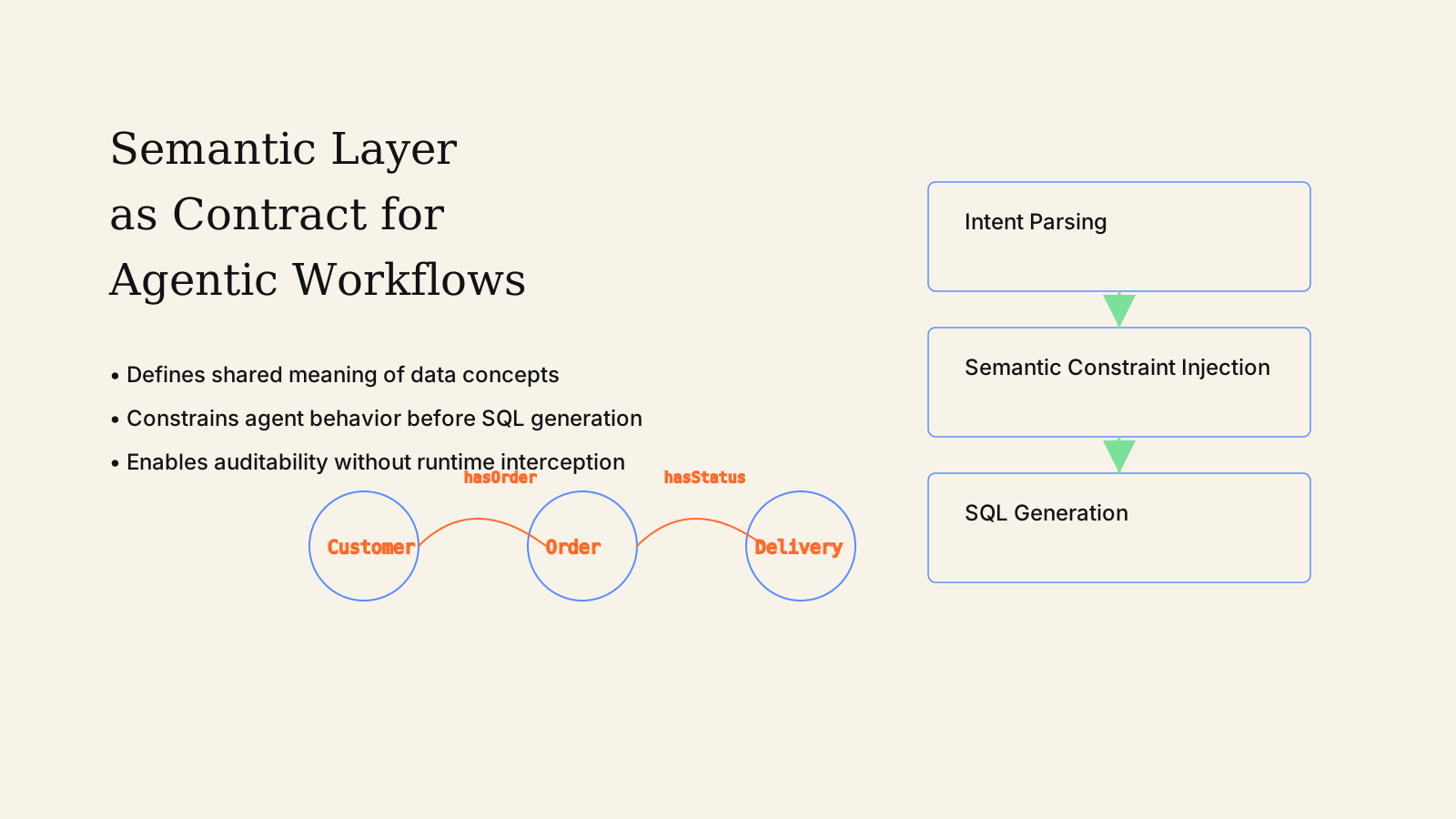
In simple Q&A, it enhances NL2SQL input. In complex agentic workflows, it becomes the orchestration nucleus:
| Agent Phase | Key Semantic Layer Responsibilities |
|---|---|
| Intent Recognition | Parse raw requests into semantic graph paths (e.g., (Customer)-[has_order]->(Order)-[has_status]->'shipped') |
| Plan Generation | Determine cross-system coordination needs using relationships & rules (e.g., check CRM tier first, then ERP status) |
| Execution Guardrails | Inject access predicates, PII masking, sampling limits (e.g., LIMIT 10000) |
| Result Interpretation | Map raw SQL output back to business concepts (e.g., SUM(amount) → total_revenue → “East China Total Revenue”) |
| Audit & Traceability | Log semantic version, permission snapshot, and rule-trigger chain for every query |
This evolution means the semantic layer is no longer static configuration—it’s part of the agent’s runtime environment, requiring hot updates, version rollback, multi-tenancy isolation, and deep integration with identity and policy engines.
Conclusion: Back to the Contract
The most dangerous mindset treats the semantic layer as a deliverable software module. In reality, it’s first and foremost an organizational consensus artifact: Finance must agree on revenue definitions; Legal must approve customer tagging; IT must declare authoritative data sources. OntiCards’ experience shows the fastest-moving customers aren’t those with the largest tech budgets—but those willing to spend two weeks jointly defining just 20 core metrics and their constraints.
Technically, the semantic layer doesn’t replace your data platform—it sits lightly atop it. You don’t need full ontology theory to start: begin with one entity-relationship diagram and one annotated glossary of key metrics. The real barrier isn’t code. It’s the willingness to pay the cost of consensus—for certainty.
References
This article is based on publicly available industry material and the author's practical experience. (No external citations.)