Decision Models Are Booming. Their 0.8 Isn't a Promise.
Ten vendors shipped decision models in a month — but benchmarks show nearly all are overconfident. One vendor's 0.8 isn't another's. Calibration is your job.
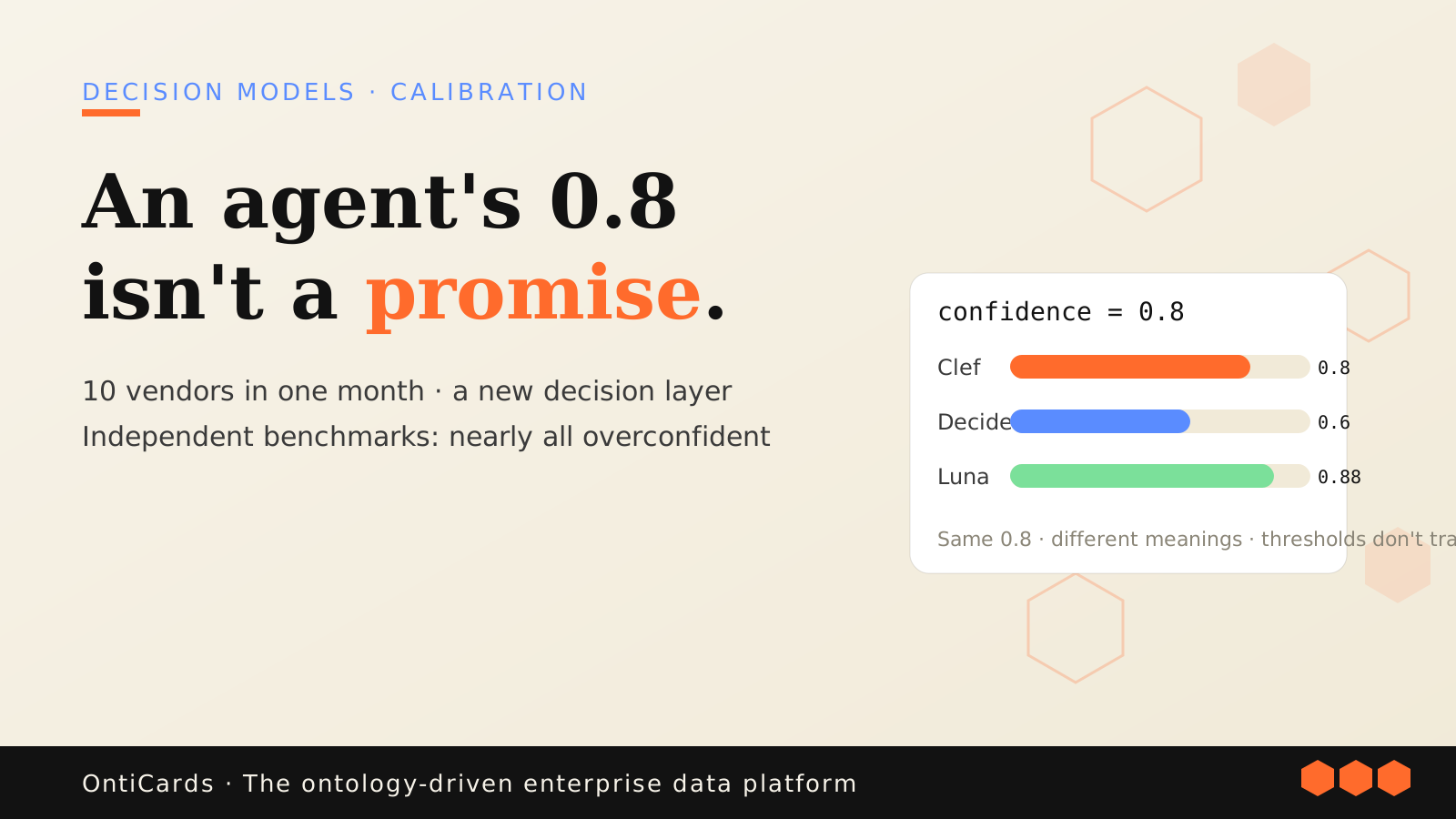
The agent stack grew a dedicated decision layer in October — but independent benchmarks show nearly every decision model is overconfident, and one vendor's 0.8 is not the same thing as another's. The expensive part is no longer inference; it's pinning down what those confidence numbers actually mean on your data, with your labels and your business definitions.
One Month, One Model to Ten
First, a definition for readers who missed the start of this race: a decision model is an AI model that picks from a fixed set of answers and returns a probability for each, instead of generating text. Your application sends it a state plus a list of questions with fixed options; it scores every option and writes nothing.
These models target the high-frequency small calls agents make constantly: which queue a ticket routes to, which tool to invoke next, whether an output passes a guardrail, whether to escalate to a human. Chat models used to answer these one token at a time — slow and costly. Decision models cut generation out entirely: the AWS Strands team literally removed the model's token-output head, and Liquid AI's d1 family "doesn't produce tokens but answers in a single forward pass."
TypeSafe opened the category with Jev on September 15. Ten vendors followed within a month (per Tech AI Wire's October 15 tally and Zhiding's October 17 report):
| Date | Release | Form |
|---|---|---|
| Sep 15 | TypeSafe Jev (category creator) | Hosted API |
| Sep 29 | OpenAI Decisions API (powered by GPT-6 Luna) | Public beta, announced at DevDay |
| Oct 1 | Cloudflare Clef / Clef-flash | Open weights, Apache 2.0 |
| Oct 1 | AWS Strands Decider 2B | Open source, 1.9B parameters |
| Oct 1 | Perplexity pplx-decider | Open weights, Apache 2.0 |
| Oct 7 | Liquid AI d1-3B / d1-omni-600M | Open weights |
| Oct 9 | Cloudflare Clef-omni; Microsoft-Decision-1 in Foundry | Open / hosted |
The question types have converged to three: yes-or-no (probability of "yes"), pick-one (a probability per option), and rate (a probability-weighted score on an ordered scale). Hosted input pricing runs from $0.02 to $0.24 per million tokens — a 12x spread. InfoWorld worked through Microsoft's numbers: one dollar covers more than 275,000 similar short decisions.
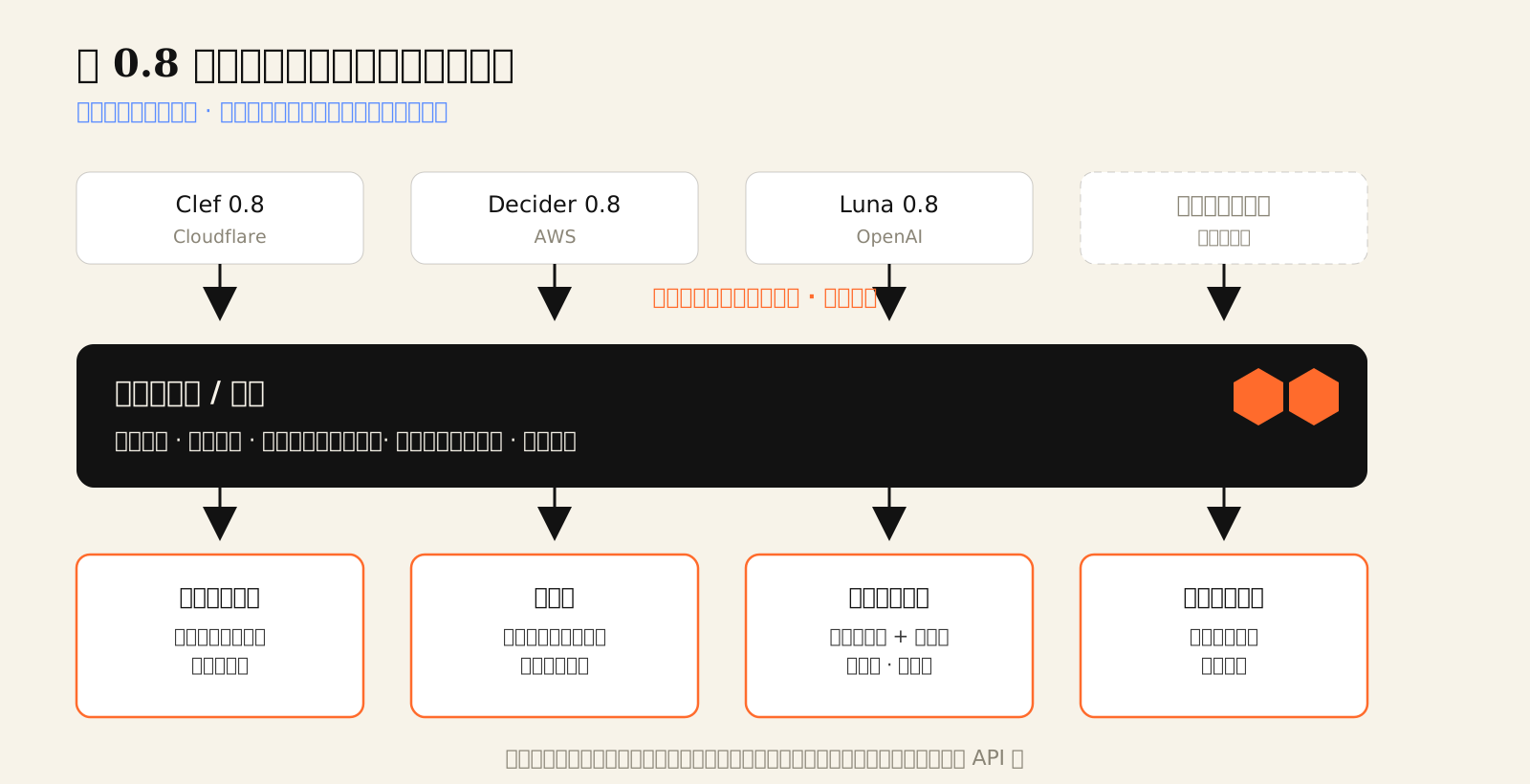
Inside an agent stack, the layer looks like this:
The Benchmark Cold Water: Nearly Everyone Is Overconfident
Speed and cost figures come from the vendors themselves. So what do independent numbers say? Artificial Analysis put thirteen decision models on one board (mirrored by SystemOne Models on October 16), and the finding isn't flattering: at almost every probability level, every decision model was right less often than its own probability claimed.
Calibration error (ECE) also swings wildly by task type. Jev's calibration error is just 0.05 on tool-calling tasks but 0.40 on the knowledge-and-reasoning test Humanity's Last Exam — the same model, the same "I'm 80% sure," meaning two different things depending on the job.
The Laya case is the most vivid: its own team found the model scored 0% on Khmer text while reporting 95.2% average confidence. "A precise-looking probability can give an uncertain decision more authority than it deserves," as Amit Kumar Jena, AI development manager at Kanerika, told InfoWorld — a sentence worth pinning above every dashboard that consumes these numbers.
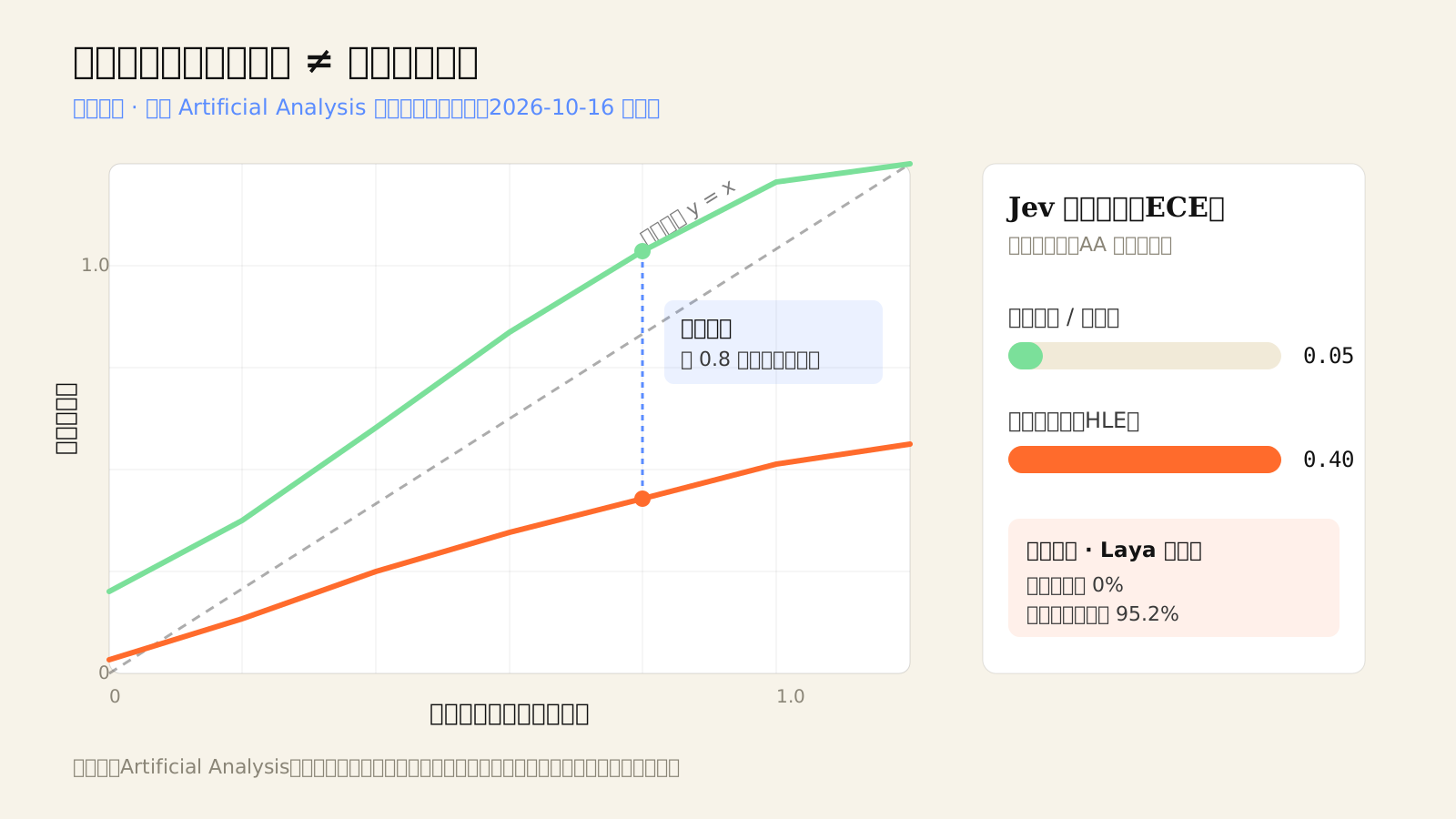
One caveat: the chart above is illustrative, drawn from public benchmark coverage; for exact readings, check Artificial Analysis's original calibration bins. Also note the leaderboard itself is contested — d1-ultra (65.2) and Jev 1.13 (57.5) swap places on a rival index. Even the benchmarks are still fighting.
Whose Zero-Point-Eight Is It, Anyway?
The sharpest warning of this wave comes from Ashish Chaturvedi, executive research director at HFS Research, speaking to Zhiding: "Every model's confidence score has its own meaning. A 0.8 from Clef, Decider or Luna doesn't represent the same reliability — a threshold tuned for one model cannot be carried over to another."
He also located where the complexity actually piles up: not in inference, but in evaluation and calibration. Switch vendors, or run two at once, and every threshold has to be recalibrated against your own data.
Aditya Ranjan, a senior data engineer at grocery giant H-E-B, filled in the other half of the ledger: the cost of being wrong. A bad decision can trigger a chain of downstream actions whose cleanup costs more than the inference you saved. His advice: evaluate architectures on end-to-end workflow latency, cost per successful decision, decision accuracy, operational overhead, and failure-recovery cost — not the inference bill alone.
Chaturvedi's governance point may matter more long-term: every question, answer set and threshold encodes a slice of business policy — when refunds get approved, what counts as a major incident. Once teams accumulate hundreds of these "decision recipes," they form a new logic layer that needs version control, ownership and review, just like prompts did.
So Whose Job Is Calibration? Yours.
The loop closes here: vendors don't calibrate for you. OpenAI's Decisions API documentation publishes no calibration figures and tells developers to set thresholds from their own labeled data. AWS's Strands Decider 2B release notes say, plainly, "validate on your workloads." TypeSafe's Jev is hosted — you can't inspect the model at all.
A workable calibration loop, assembled from OpenAI's developer guide and vendor recommendations:
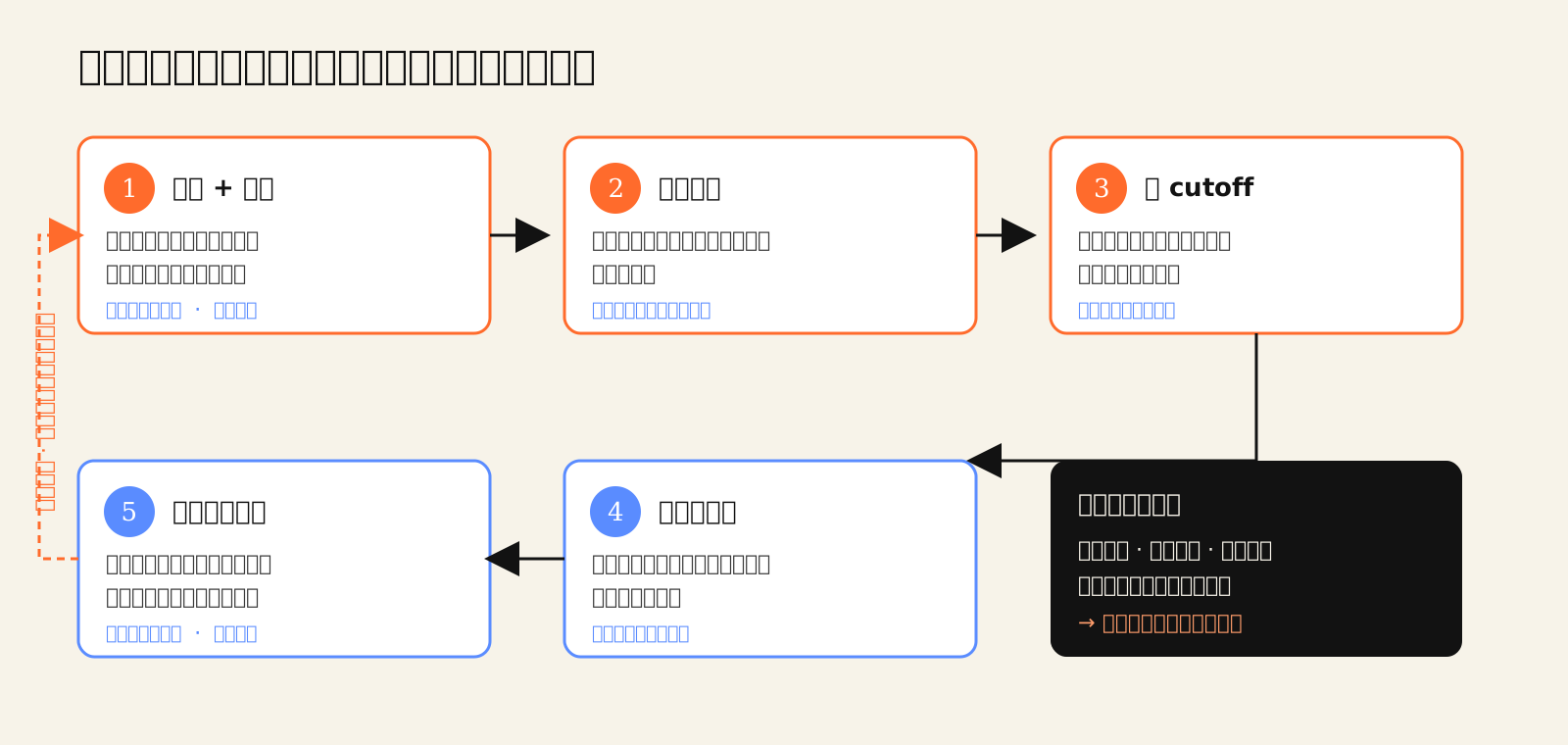
- Collect a few hundred historical cases per question type and have domain experts label the correct answers;
- Sweep the cutoff and plot the trade-off between wrong-acceptances and the share of cases sent to human review;
- Set the cutoff where marginal review cost stops buying meaningful accuracy;
- Keep a held-out set that never participated in tuning, and re-measure before promoting anything;
- Run new decision recipes in shadow mode — scoring live traffic without acting on it — promote only on a written acceptance rule, and keep the old route available for rollback.
Now look at the raw materials this loop consumes: historical cases, expert labels, business definitions, and the answer to "what counts as a major incident." Not one of them lives at the model vendor. It's the same wall we keep hitting in checkable text-to-SQL and semantic layer decay: when agents enter core business processes, what they collide with is organizational knowledge — definitions, metrics, labels, accountability.
Decision models push that wall one inch closer: now even "what does 0.8 mean" is a question your enterprise has to answer.
The Takeaway
Decision models are a good thing — carving enumerable, high-frequency micro-decisions out of agents saves real money and latency, and the direction is sound. The catch is that they hand the last mile back to the enterprise: thresholds tuned on your data, definitions owned by your organization, and hundreds of decision recipes that someone has to govern.
If your team is wiring these components into workflows, get three things ready first: labeled historical cases organized by question type, a definition table that pins down your business metrics, and a semantic layer that keeps those assets maintainable over time. That's the problem OntiCards works on — using ontologies and data cards to pull your enterprise's definitions, metrics and data quality into one layer (see the product), so that whichever model sits on top, your calibration foundation doesn't have to be rebuilt from scratch.
Running into this in your own stack? Say hello at hello@onticards.com — we'd like to hear about your use case.
References
- Zhiding (至顶网): "AI智能体决策层独立化,科技巨头竞相布局专用模型" (Oct 17, 2026) — https://www.zhiding.cn/ai-infrastructure/2026/1017/3202554.shtml
- Tech AI Wire: "AI decision models, explained" (Oct 15, 2026) — https://dev.to/techaiwire/ai-decision-models-explained-59mh
- Artificial Analysis leaderboard (via SystemOne Models): "Jev benchmarks: every public evaluation in one place" (data as of Oct 16, 2026) — https://systemonemodels.org/guides/jev-benchmarks
- Agor: "Whose Eighty Percent" — https://agor.me/blog/whose-eighty-percent
- AiCybr: "AWS Strands Decider 2B: Open Decision Model for Local AI Agents" — https://aicybr.com/blog/aws-strands-decider-2b-local-agent-decision-model
- World Programming: "OpenAI Decisions API: A Practical Developer's Guide" — https://www.worldprogramming.org/posts/openai-decisions-api-a-practical-developers-guide-6wfccn