Token Economics: Agent Bills Expose Your Data Debt
Model prices are collapsing, yet token consumption is exploding. Your agent's total bill is decided by data organization, not model pricing. Here's the math.
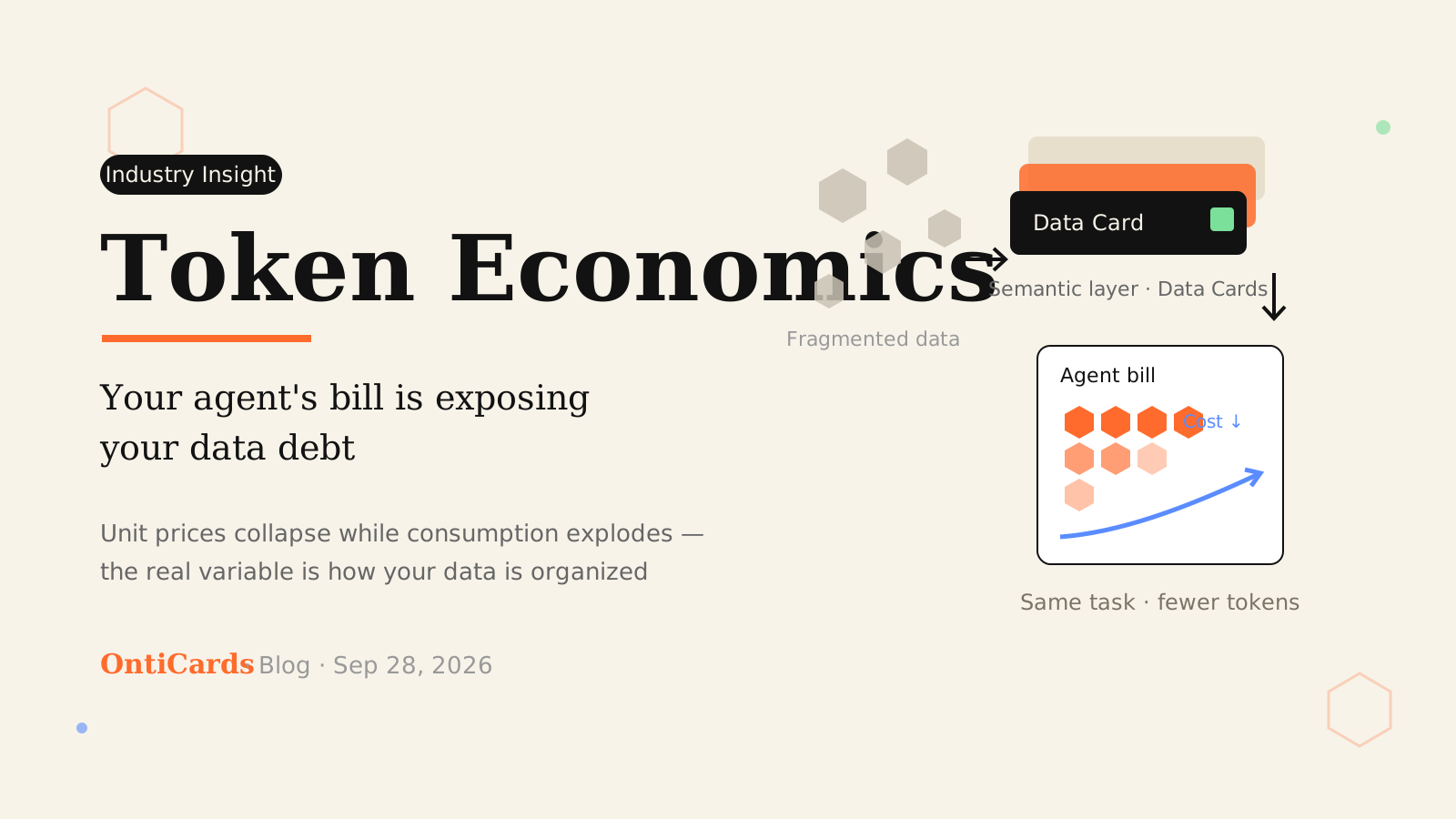
Two things happened in the same week. Model prices collapsed — frontier labs undercut each other within hours, and specialized small models drove the cost of a single judgment down by three orders of magnitude. Meanwhile, China's annual token consumption is racing toward 100 quadrillion. The total bill for running AI agents is no longer set by model pricing. It's set by how well your enterprise data is organized. Here's the math.
One Week, and the Unit Price of Intelligence Crashed
Start with the price war. According to TechCrunch and other outlets, Anthropic and OpenAI shipped new frontier models back-to-back in late September: Claude Opus 5.5 topped the Artificial Analysis leaderboard at 58 points while cutting per-task cost to $5.98, down from Fable 5.1's $7.63. GPT-6 Sol and Luna undercut GPT-5.6's promotional pricing by 50%, with Luna opened up to free-tier users.
The more telling numbers came from smaller models. Research covered in The Neuron's weekend digest shows Jev, a specialized classification model, scoring $0.044 per 1,000 judgments as an LLM judge — versus $12.182 for GPT-6 doing the same job. That's roughly 277x cheaper, at one-twelfth the latency. OpenRouter reports Jev already handles 27% of its weekly classification volume, and a16z argues this class of models could deflate computer-use costs by 100x.
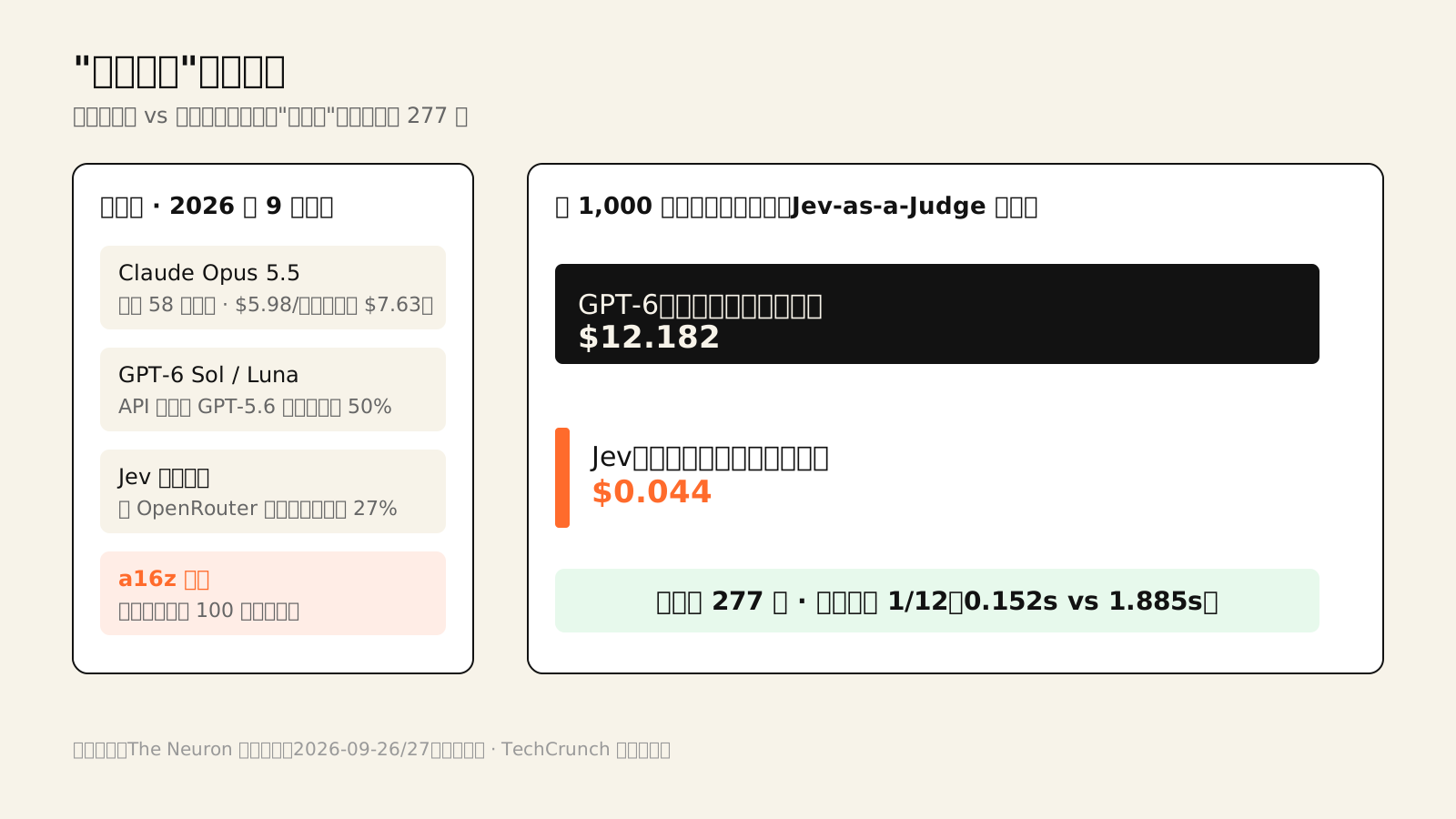
In plain terms: intelligence is turning from a luxury good into a commodity. Everyone can afford it now.
Prices Fall, Bills Explode
But collapsing unit prices haven't shrunk total bills — they've launched them.
China Telecom Research Institute's 2026 Report on AI Infrastructure in the Agentic Era projects that China's annual token consumption will reach 100 quadrillion (10¹⁷) in 2026, exceeding 35 quintillion (3.5×10¹⁹) by 2030 — a compound growth rate of nearly 12x per year. Inference is expected to account for 80% of China's compute market by 2029. International forecasts put active agents worldwide at nearly 80 million in 2026, growing to 2.2 billion by 2030.
How steep is the curve? China's National Data Resource Survey reports daily token calls grew from 1 trillion in early 2025 to 100 trillion by year-end, passing 140 trillion by March 2026. The recently concluded Global Digital Trade Expo in Hangzhou debuted a dedicated "Token Zone" showcasing the full token supply chain. Hunan province even issued China's first "token-backed loan" — 8 million RMB in credit underwritten not by collateral, but by a company's monthly token consumption. Token flow is becoming a new kind of operating statement.
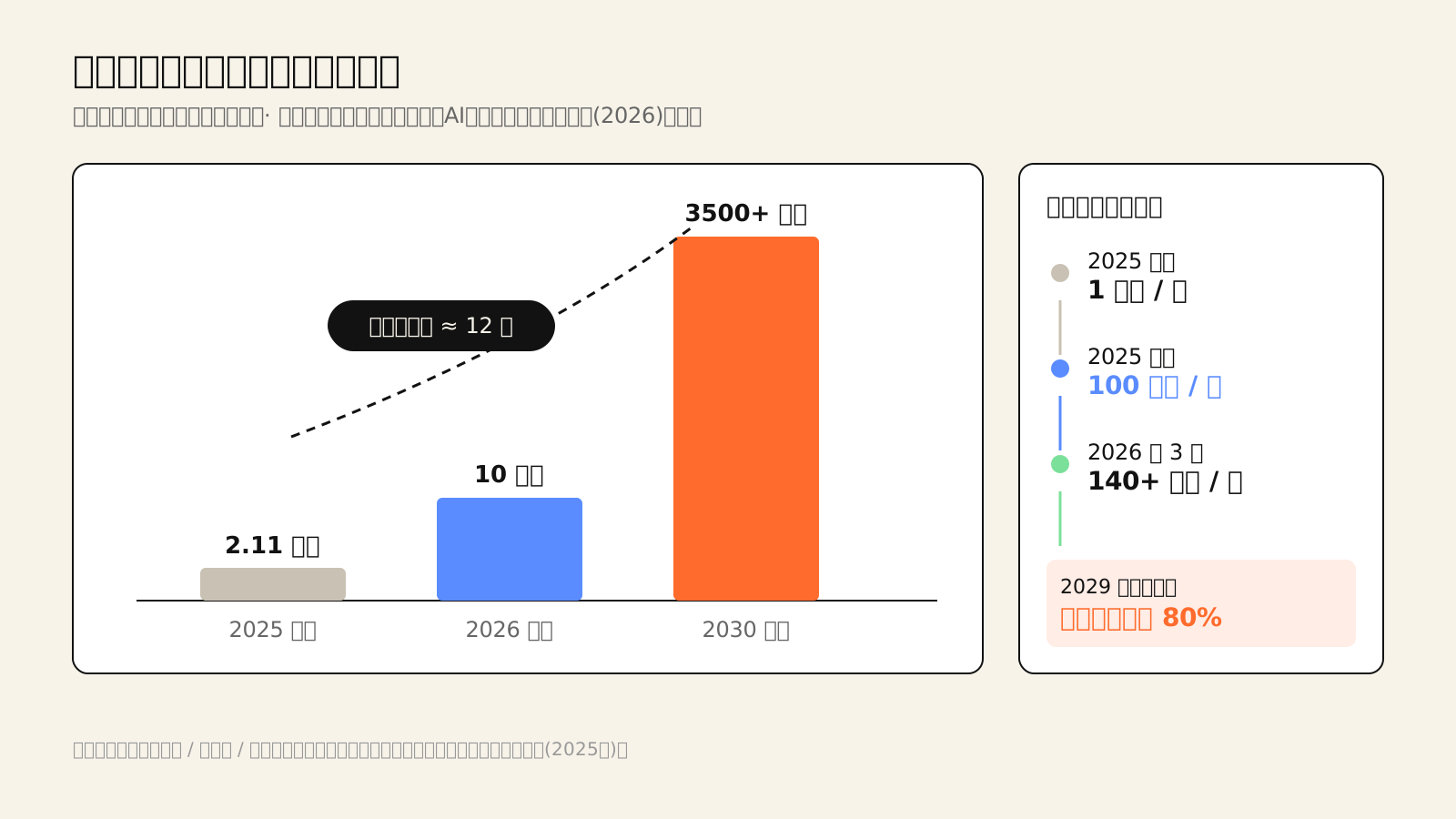
Unit price down 50%, volume up 50x. That's the real arithmetic of enterprise AI cost today.
Where Do All Those Tokens Go?
Here's the problem: not all of those tokens convert into business value. As one Chinese analysis of the token economy put it: "Tokens can count intelligence, but they can't price it. The second half of the token economy comes down to a harder question: who can complete more complex tasks with fewer tokens."
In enterprise settings, tokens typically leak in three places:
- Garbage in context. When data is fragmented and business definitions unclear, every question drags in piles of irrelevant schemas, field docs, and chat history. Tokens burn before the real question is even asked.
- Retry loops. The model can't find the authoritative business definition, produces a wrong answer, the user follows up, the system retries — each round multiplies the bill.
- Agent re-reading. To confirm a single fact, an agent scans table after table, system after system. The more fragmented the data, the more loops it runs.
IDC's research points to the same bottleneck: over 70% of enterprise AI projects stall on data cleansing, governance, adaptation, and the supply of high-quality datasets — not on model capability. The counterexample proves the point: Kuaishou reports its Data Agent delivers a median 13x speedup per task, with one metric computation moving from Spark ETL to a new OLAP engine cutting runtime from 90 minutes to 42 seconds and cost by 92%. When the data foundation is in order, tokens go further.
Aim Every Token at a Data Card
This is exactly why OntiCards is built around Data Cards. A Data Card is an AI-structured specification for a single data source, table, or document: it records only metadata — what this table is, what each field means, how the business defines its metrics, what kinds of questions it can answer — and none of the underlying transactional data.
The effect on your token bill is structural:
| Dimension | Direct data access / naive RAG | OntiCards Data Cards + semantic layer |
|---|---|---|
| What goes into context per question | Piles of schemas, field docs, examples | Minimal card metadata, retrieved on demand |
| Where business definitions live | In people's heads; the model guesses | Written into cards; the model reads it right the first time |
| Wrong answers and retries | Routine; every retry is a fresh bill | Definitions fixed; retry rates drop sharply |
| Agent's path to data | Scans table after table to confirm facts | Card addressing index reaches the target data directly |
| Auditability of each answer | Hard to trace | Fully auditable reasoning chain |
The mechanism in one sentence: a semantic layer turns "guessing an answer out of a data swamp" into "looking up an answer under known definitions." The former's cost is probabilistic and grows exponentially with data chaos; the latter's is deterministic and falls linearly with card coverage. We've explored different facets of this shift before — in the war for data context and on designing for model fatigue. Token economics is simply its most direct financial footnote.
The Bottom Line
The first half of the token economy was about capacity, price, and call volume. The second half — the direction China Telecom Research Institute's report points to — is about task completion per token. As model prices approach zero, the models themselves stop being the moat. Your data foundation — how deeply your data is understood, how well it is organized — is the true slope of your agent cost curve.
Curious how much headroom your data foundation has on the token bill? Reach us at hello@onticards.com, or start with the full design of Data Cards and the semantic layer on our product page.
References
- China Economic Net: "China's Token Consumption to Reach 100 Quadrillion in 2026" (China Telecom Research Institute, 2026 Report on AI Infrastructure in the Agentic Era)
- Toutiao · Code Farmer Finance: "Big Data Starts Counting Small Change" (Digital Trade Expo Token Zone, token-backed loans, Kuaishou Data Agent figures)
- Toutiao · Shen Xieyue: "Two Top Models Launched 90 Minutes Apart" (Opus 5.5 vs GPT-6 Sol/Luna pricing)
- The Neuron: Everything That Happened in AI This Weekend (September 26–27, 2026) (Jev-as-a-Judge cost comparison, OpenRouter classification volume)