The Key Role of the Semantic Layer in Enterprise Data Intelligence and AI Agents
This article explores the crucial role of the semantic layer in enterprise data governance and the implementation of AI agents. By constructing a unified semantic layer, it is possible to achieve data consistency and explainability, thereby enhancing the accuracy and reliability of AI agents. The article also analyzes specific applications of the semantic layer and engineering trade-offs in practi
The Critical Role of the Semantic Layer in Enterprise Data Intelligence and AI Agent Implementation
In the current process of enterprise data governance and AI Agent implementation, the role of the semantic layer is increasingly being recognized. By building a unified semantic layer, enterprises can achieve data consistency and explainability, thereby enhancing the accuracy and reliability of AI Agents. This article will delve into the key role of the semantic layer in enterprise data intelligence and analyze its specific applications and engineering trade-offs through practical scenarios.
Basic Concepts and Importance of the Semantic Layer
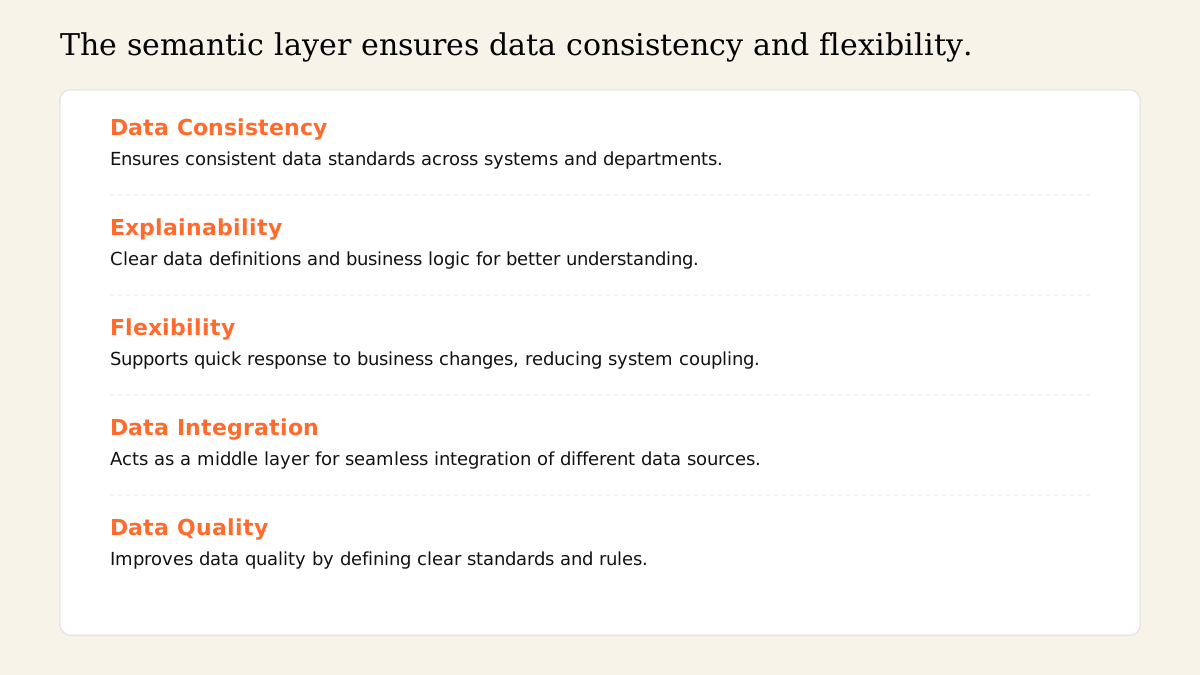
The semantic layer is an abstraction layer located between the data storage layer and the application layer, providing a set of unified data definitions and business logic to ensure that different systems and users can understand and use data in a consistent manner. The main functions of the semantic layer include:
- Data Consistency: By defining unified data standards and business rules, it ensures that the data口径一致 across different systems and departments.
- Explainability: Through clear data definitions and business logic, the meaning of the data becomes more transparent, making it easier to understand and use.
- Flexibility: Through dynamic data mapping and transformation, it supports quick responses to changes in business needs, reducing system coupling.
In enterprise data governance, the importance of the semantic layer is mainly reflected in the following aspects:
- Data Integration: The semantic layer can serve as an intermediate layer for data integration, unifying and standardizing data from different sources, thus achieving seamless data integration.
- Data Quality: By defining clear data standards and business rules, it can effectively improve data quality, reducing data errors and inconsistencies.
- Data Analysis: The unified data view provided by the semantic layer makes data analysis simpler and more efficient, reducing the complexity of data processing.
Application of the Semantic Layer in AI Agents
An AI Agent is an intelligent system capable of autonomously executing tasks and making decisions. In an enterprise environment, AI Agents can be used for automated data processing, business process optimization, and other scenarios. The application of the semantic layer in AI Agents is mainly reflected in the following aspects:
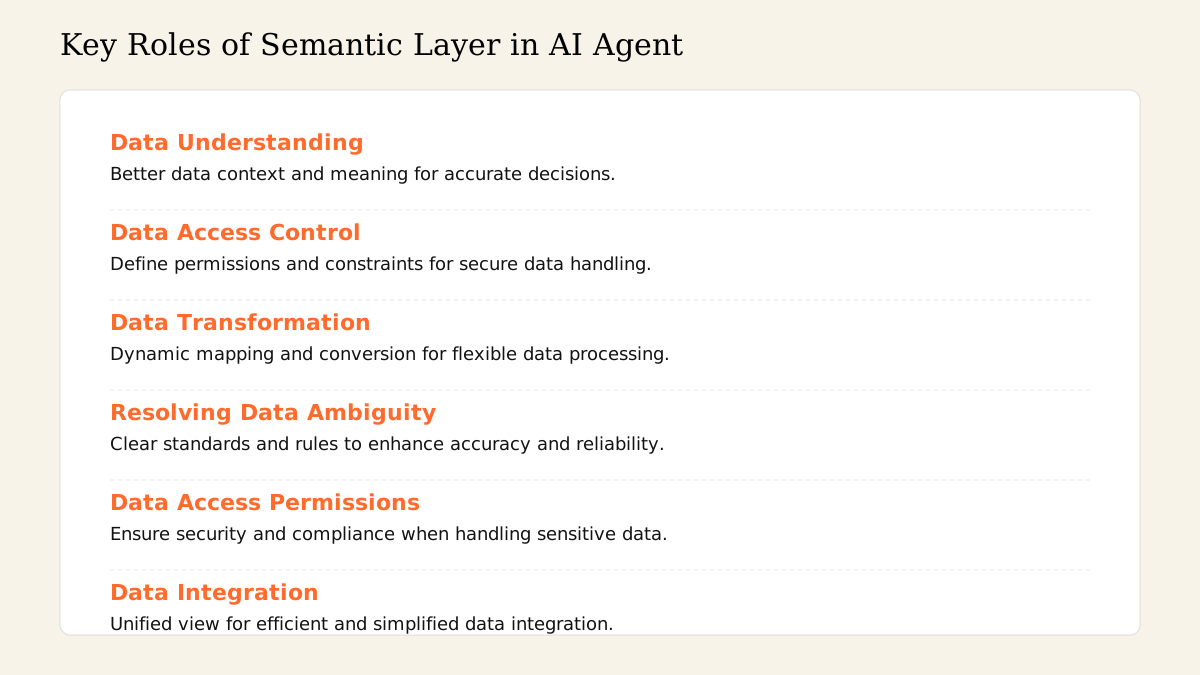
- Data Understanding: Through the semantic layer, AI Agents can better understand the meaning and context of the data, thereby making more accurate decisions.
- Data Access Control: The semantic layer can define data access permissions and constraints, ensuring that AI Agents do not violate security and privacy policies when handling data.
- Data Transformation: The semantic layer provides dynamic data mapping and transformation capabilities, allowing AI Agents to flexibly handle different data formats and structures.
In practical applications, the semantic layer can help AI Agents solve the following problems:
- Data Ambiguity: By defining clear data standards and business rules, it eliminates ambiguity in the data, improving the accuracy and reliability of AI Agents.
- Data Access Permissions: Through the data access permissions and constraints defined by the semantic layer, it ensures the security and compliance of AI Agents when handling sensitive data.
- Data Integration: The unified data view provided by the semantic layer simplifies the data integration process, improving the efficiency of data processing.
Building and Maintaining the Semantic Layer
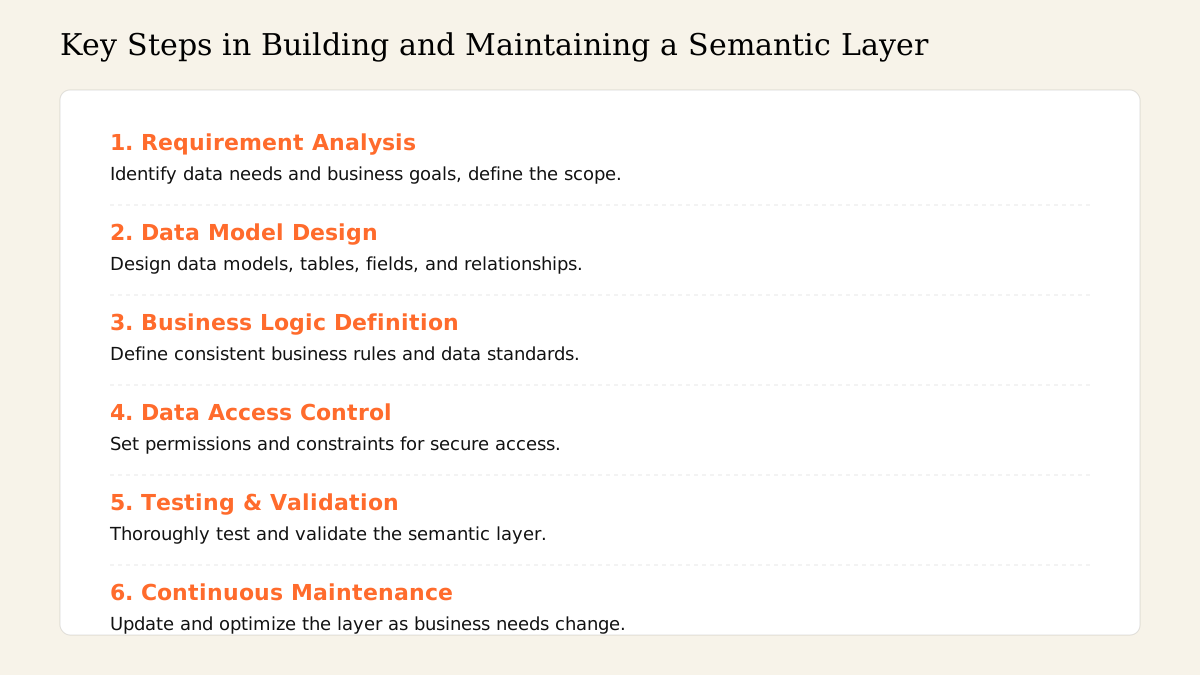
Building and maintaining an efficient semantic layer requires considering multiple factors, including data model design, business logic definition, and data access control. The following are some key steps in building and maintaining a semantic layer:
- Requirements Analysis: Clearly define the enterprise's data requirements and business objectives, determining the functionality and scope of the semantic layer.
- Data Model Design: Design a data model that meets the enterprise's needs, including table structures, field definitions, and relationship mappings.
- Business Logic Definition: Define unified business rules and data standards to ensure data consistency and explainability.
- Data Access Control: Define data access permissions and constraints to ensure data security and compliance.
- Testing and Validation: Thoroughly test and validate the semantic layer to ensure its functionality and performance meet the enterprise's needs.
- Continuous Maintenance: Continuously update and optimize the semantic layer based on changes in business needs to maintain its long-term effectiveness and reliability.
In collaboration with some clients, a common issue is the inconsistency between financial and production metrics in the same report. By building a unified semantic layer, this problem can be effectively resolved, improving data consistency and accuracy. Additionally, in scenarios with complex permission metrics, implementing semantic layer constraints is often more cost-effective than adjusting models, significantly reducing the error rate.
Relationship Between the Semantic Layer and the Data Middle Platform
The data middle platform is an architectural pattern widely adopted by enterprises in recent years during their digital transformation, aimed at centrally managing and sharing data resources to achieve efficient data utilization and maximize value. The semantic layer is closely related to the data middle platform and can play a significant role within it.
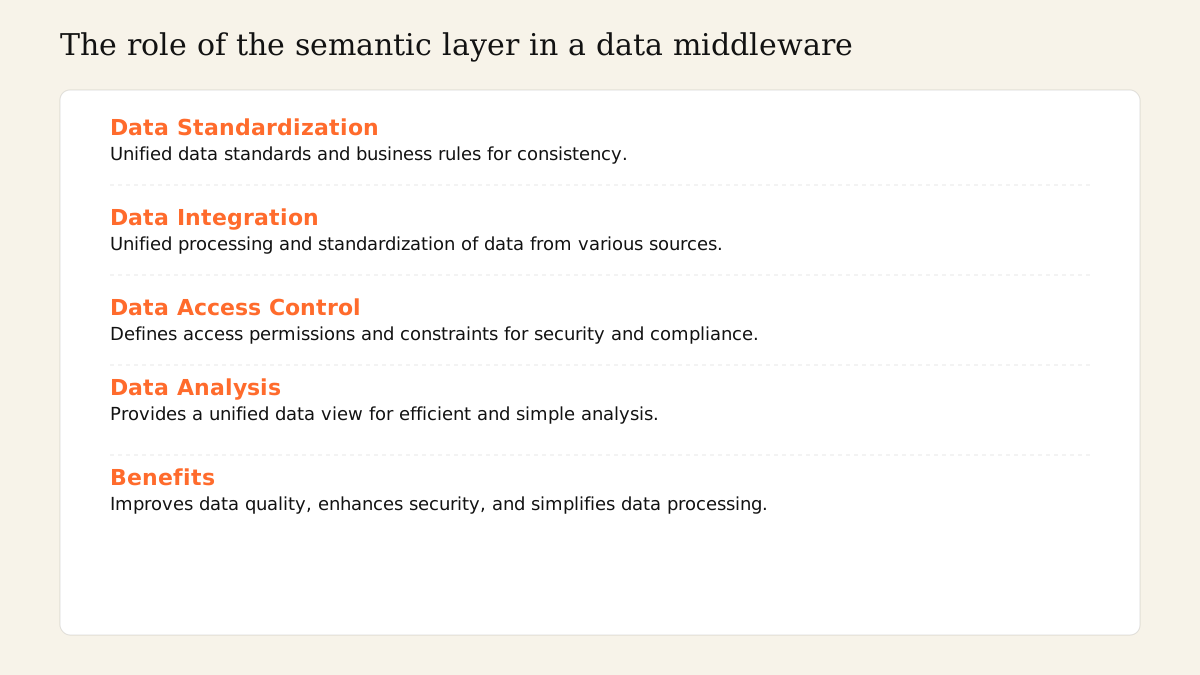
- Data Standardization: The semantic layer supports data standardization in the data middle platform by defining unified data standards and business rules, ensuring consistent data口径 across different systems and departments.
- Data Integration: As an intermediate layer for data integration, the semantic layer can unify and standardize data from different sources, achieving seamless data integration.
- Data Access Control: The semantic layer can define data access permissions and constraints, ensuring the security and compliance of the data middle platform when handling data.
- Data Analysis: The unified data view provided by the semantic layer makes data analysis simpler and more efficient, supporting various application scenarios of the data middle platform.
In practical applications, the combination of the semantic layer and the data middle platform can bring the following benefits:
- Improved Data Quality: By defining clear data standards and business rules, it can effectively improve data quality, reducing data errors and inconsistencies.
- Enhanced Data Security: Through the data access permissions and constraints defined by the semantic layer, it ensures data security and compliance.
- Simplified Data Processing: The unified data view provided by the semantic layer simplifies the data processing process, improving data processing efficiency.
Conclusion
The semantic layer plays a crucial role in enterprise data governance and AI Agent implementation. By building a unified semantic layer, enterprises can achieve data consistency and explainability, enhancing the accuracy and reliability of AI Agents. In practical applications, the semantic layer not only solves issues such as data ambiguity and access permissions but also supports data standardization and integration in the data middle platform. Therefore, in the process of advancing digital transformation, enterprises should place high importance on the construction and maintenance of the semantic layer to fully leverage its critical role in data intelligence.
References
- (No external references)