The Semantic Layer Is the Agent’s Contract
The semantic layer isn’t a decorative module—it’s the verifiable, auditable contract between AI agents and enterprise data systems. This article analyzes its role in NL2SQL, permission alignment, and ontology modeling.
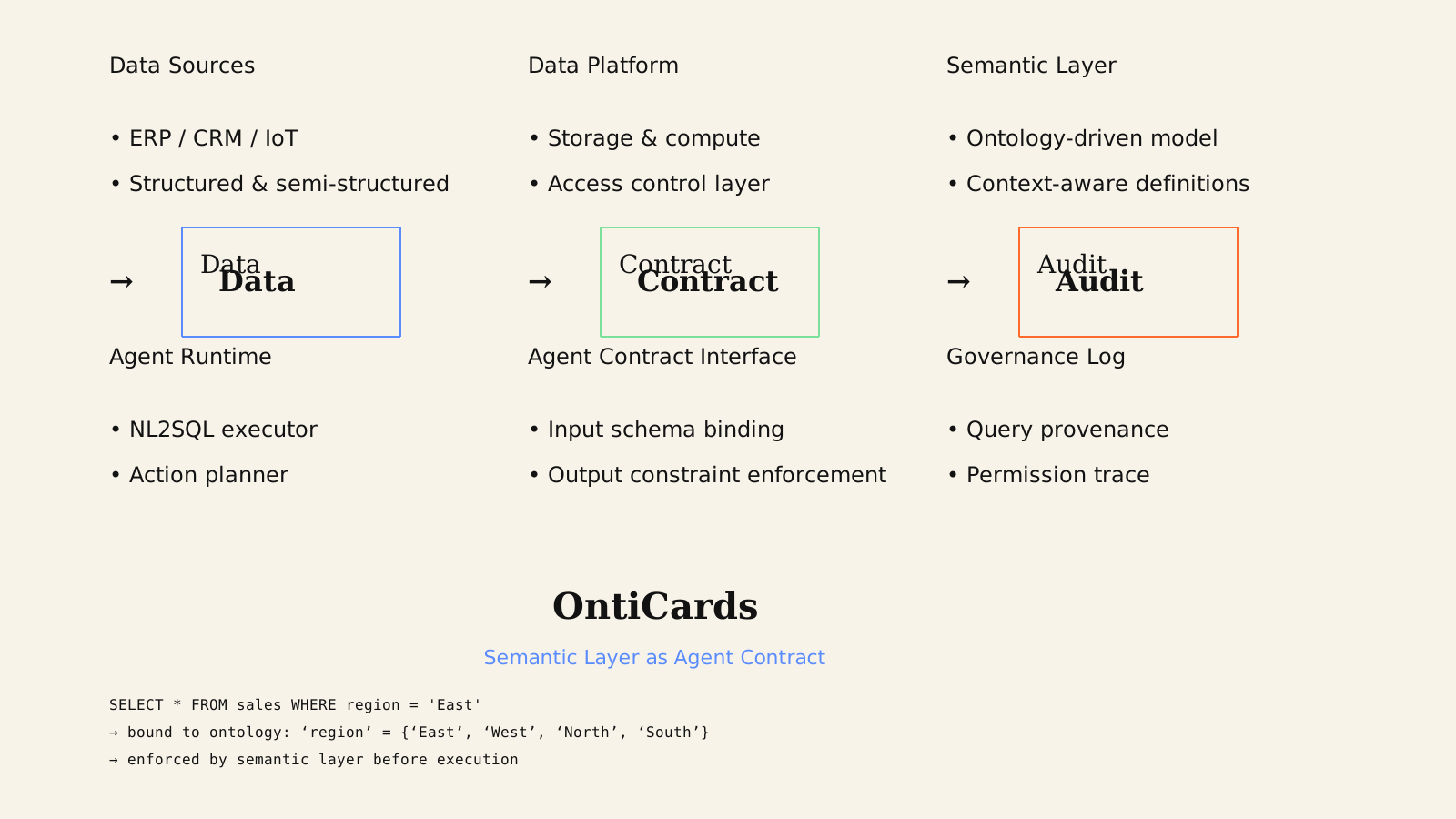
Enterprises deploying AI agents most frequently encounter not capability gaps—but uncontrolled behavior: the same natural language request, issued at different times or by different agents, may hit different tables, trigger inconsistent permission logic, or return results with mismatched business semantics. The root cause lies not in the models themselves, but in the absence of a shared, enforceable “data contract”—and the semantic layer is precisely that contract made operational.
The semantic layer is a contract—not a mapping
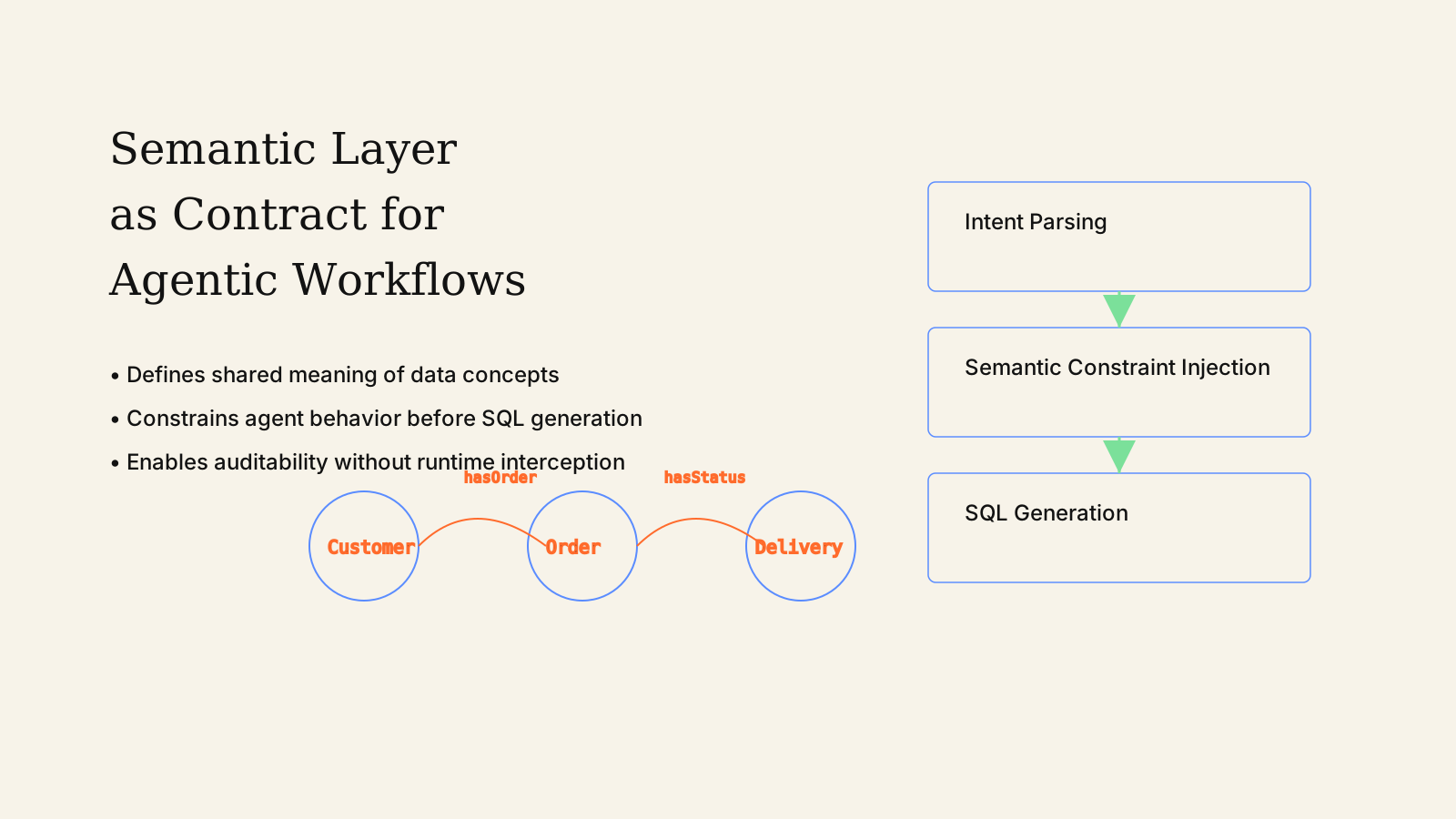
Traditional semantic layers are often reduced to configuration interfaces: field aliases and table joins. This view overlooks their governance essence: they define what may be said, how it may be said, who may say it, and what form the result must take. When an agent submits an NL2SQL request, the semantic layer does not passively translate SQL—it actively validates:
- Whether the input falls within a pre-defined context (e.g., “last quarter” must bind to the fiscal calendar, not the natural calendar);
- Whether ambiguous concepts have resolution rules (e.g., “customer” means the contracting entity in sales, but the service recipient in support);
- Whether outputs satisfy business consistency constraints (e.g., all revenue metrics must be validated against the “revenue recognition policy”).
This goes beyond metadata management—it enters the domain of contract engineering.
NL2SQL’s bottleneck isn’t generation—it’s constraint injection
Most current NL2SQL efforts optimize model fine-tuning or prompt engineering. Yet in production, accuracy ceilings are usually set by the semantic layer. For instance, when collaborating with manufacturers, it’s common for the same report to yield conflicting numbers across finance and production teams. The key to improvement here isn’t swapping in larger models—it’s codifying business knowledge like “cost center assignment rules” or “work order status transitions” into semantic-layer constraints—and enforcing them during query parsing, not after.
In short: models get the phrasing right; the semantic layer ensures the phrasing is the only one allowed.
Permissions and business semantics must be coupled in definitions
Relying solely on RBAC or row-level policies for access control introduces “policy drift”: when a new column is added, a view is refactored, or a new analytical use case emerges, permission rules often lag behind. The semantic layer, however, is inherently context-aware. It can embed access permissions as intrinsic properties of concepts:
concept: SalesRevenue {
  permission: "finance_team AND (region = 'APAC')"
  validity: "valid_from <= CURRENT_DATE <= valid_to"
}
This declarative approach makes permissions inseparable from meaning—not external policies. When an agent requests “APAC Q3 revenue,” the semantic layer automatically enforces permission checks and time-range normalization—no runtime policy engine required.
Ontology-driven modeling: making contracts inferable and evolvable
Lightweight semantic layers depend on manual configuration and struggle with complex business evolution. Sustainable agent operation demands ontology-based modeling: defining not just what something is, but why it’s defined that way—and how it logically relates to other concepts.
For example, defining the Customer concept includes not only source fields, but also logical assertions:
isSubClassOf Person
hasRelationship contractWith Company
hasConstraint lifecycleStatus IN {‘Prospect’, ‘Active’, ‘Churned’}
These assertions endow the semantic layer with basic reasoning capacity: when an agent queries “number of open contracts associated with churned customers,” the system can infer the necessary joins and constraints—without relying on hand-written SQL.
Organizational trade-off: contract first, intelligence second
Many teams attempt “one-step deployment”: training agents directly on raw database schemas. The result? Solid test-set performance—but erratic behavior in production due to frequent business changes. A more robust path unfolds in two phases:
- Stabilize the contract first: Use the semantic layer to unify data semantics, permission boundaries, and business rules—establishing a stable input surface;
- Then enable intelligence: Build NL2SQL, agentic workflows, and audit trails on top of that foundation.
This appears to sacrifice early flexibility—but dramatically increases long-term maintainability. Once the contract is established, model updates, agent upgrades, or even underlying platform migrations can be isolated behind the semantic layer.
The semantic layer’s value has never been about what it does, but about what it prevents: preventing ambiguous requests from crossing business red lines, preventing permission logic from decoupling from data definitions, and preventing AI behavior from escaping organizational governance. It is not a component in a data pipeline—it is the silent, default agreement signed between people, agents, and data systems.
References
- The Semantic Layer Is Not Optional — Sisense Blog, 2023