Enterprise Data Intelligence and AI Agents: Deep Application of the Semantic Layer
This article explores the application of the semantic layer in enterprise data intelligence and AI agents, analyzing its advantages and challenges in improving data consistency, simplifying data access, and enhancing data security.
Enterprise Data Intelligence and AI Agent Implementation: Deep Application of the Semantic Layer
In enterprise data governance and AI applications, the role of the semantic layer (Semantic Layer) is becoming increasingly important. By unifying the management of business logic, data definitions, and user intent, the semantic layer not only improves the consistency and accuracy of data but also provides a more flexible way for enterprises to access data. This article will explore the application of the semantic layer in enterprise data intelligence and AI Agents, and analyze its advantages and challenges in practical implementation.
Basic Concepts and Functions of the Semantic Layer
Basic Concepts
The semantic layer is an abstraction layer located between the data source and the application, used to uniformly manage and interpret the business meaning of data. It defines the metadata, relationships, and calculation rules of data, allowing different systems and users to understand and use data in a consistent manner. Simply put, the semantic layer transforms complex underlying data structures into easily understandable business terms.
Main Functions
- Improving Data Consistency: By unifying the definition and management of the business meaning of data, it avoids misunderstandings and errors caused by inconsistent data definitions.
- Simplifying Data Access: Users do not need to understand the underlying data structure; they can obtain the required data through the interfaces provided by the semantic layer.
- Enhancing Data Security: By centrally managing data access permissions, it ensures the security of sensitive data.
- Boosting Development Efficiency: Developers can use the standardized interfaces of the semantic layer for rapid development, reducing redundant work.
Specific Scenarios
When collaborating with manufacturing enterprises, a common situation is that the same report does not match in the financial and production departments. By introducing the semantic layer, these two sets of standards can be managed uniformly, ensuring data consistency and accuracy. Additionally, in the financial industry, where compliance and audit requirements are extremely high, the semantic layer can help enterprises better manage and control data access, ensuring the legality and compliance of data usage.
Application of the Semantic Layer in AI Agents
Integration of the Semantic Layer and AI Agents
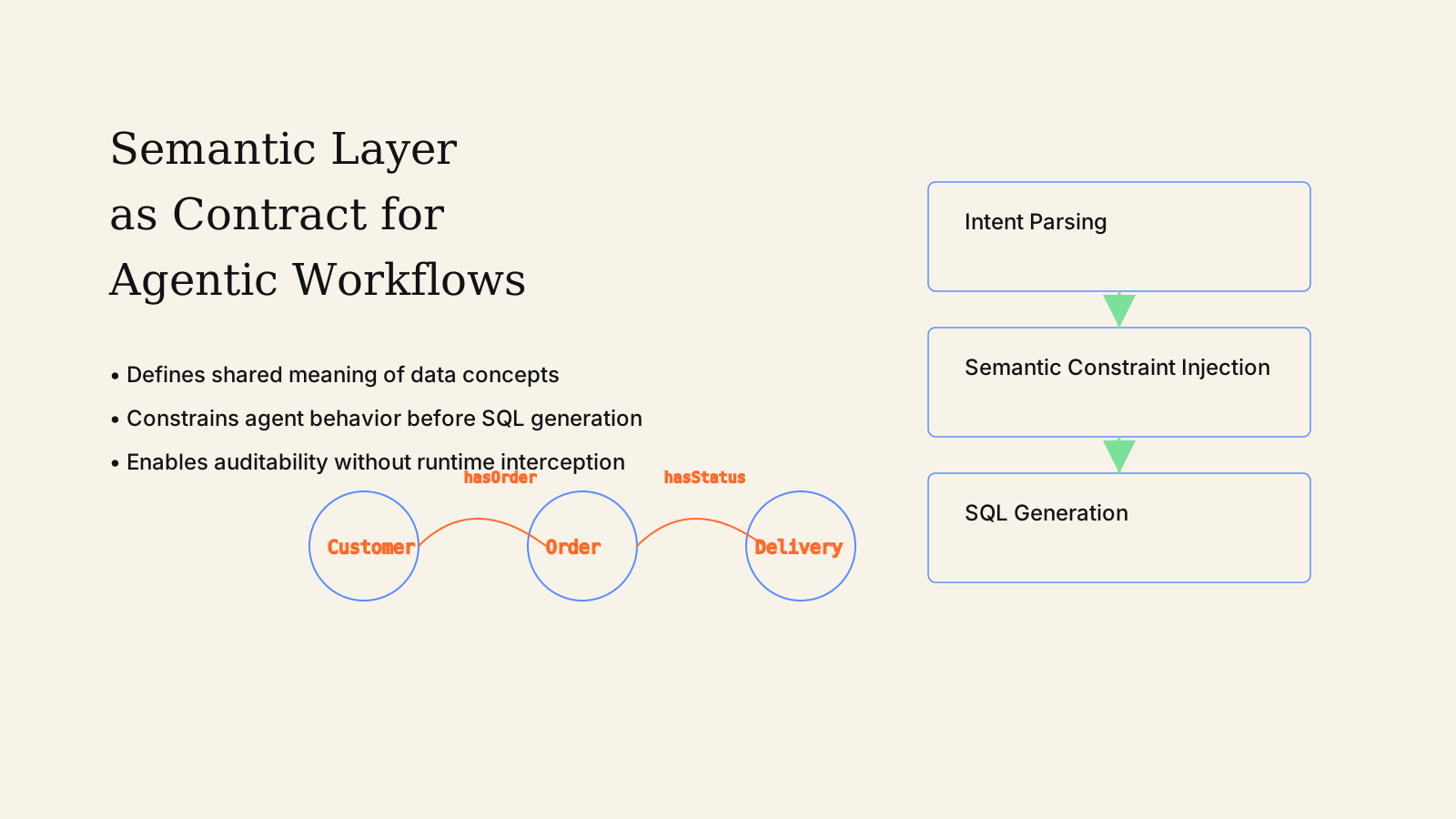
An AI Agent is an intelligent agent capable of autonomously completing tasks in a specific environment. By integrating with the semantic layer, AI Agents can better understand user intent and data needs, thereby providing more precise services. Specifically, the semantic layer provides the following support for AI Agents:
- Intent Recognition: Through the business vocabulary provided by the semantic layer, AI Agents can more accurately understand user query intentions.
- Data Access: The standardized interfaces of the semantic layer allow AI Agents to conveniently access and process data without worrying about the underlying data structure.
- Permission Management: The semantic layer can help AI Agents manage data access permissions, ensuring the legality of data usage.
Practical Cases
In collaboration with some clients, we found that by introducing the semantic layer, the performance of AI Agents in handling complex queries significantly improved. For example, in a retail enterprise, the AI Agent, through the semantic layer, understood the user's query intention and extracted relevant data from multiple sources to generate detailed sales reports. This approach not only improved the accuracy of queries but also reduced the workload of manual data processing.
Engineering Trade-offs
Although the semantic layer brings many benefits, there are also some engineering trade-offs in practical applications. First, the design and maintenance of the semantic layer require a significant investment of resources, especially when data models and business logic are complex. Second, the introduction of the semantic layer may increase system latency, particularly when processing large-scale data. Therefore, when designing the semantic layer, it is necessary to balance performance and functionality requirements to find the most suitable solution for the enterprise.
Practical Implementation of the Semantic Layer in Data Governance
Importance of Data Governance
Data governance refers to the process of managing the entire lifecycle of data, including data collection, storage, processing, analysis, and disposal. Good data governance can ensure the quality, security, and compliance of data, providing reliable data support for enterprises. The semantic layer plays an important role in data governance, mainly in the following aspects:
- Data Quality: By unifying the management of data definitions and calculation rules, it ensures the consistency and accuracy of data.
- Data Security: By centrally managing data access permissions, it ensures the security of sensitive data.
- Compliance: By standardizing the use and management of data, it ensures the legality and compliance of data usage.
Implementation Path
In practice, enterprises can implement the semantic layer through the following steps:
- Requirements Analysis: Clarify the enterprise's data governance needs and determine the functions and scope of the semantic layer.
- Design and Planning: Design the architecture of the semantic layer, plan the data model and business logic.
- Implementation and Deployment: Implement the semantic layer according to the design plan, and conduct testing and optimization.
- Operation and Monitoring: Continuously operate and monitor the semantic layer to ensure its stable operation.
Common Anti-Patterns
Common anti-patterns in implementing the semantic layer include:
- Over-Complexity: An overly complex semantic layer can lead to maintenance difficulties and increase the burden on the system.
- Ignoring User Experience: If the design of the semantic layer ignores user experience, it may make it difficult for users to understand and use.
- Lack of Flexibility: If the semantic layer is too rigid and cannot adapt to changes in the business, it will affect its actual effectiveness.
Engineering Trade-offs
When designing and implementing the semantic layer, it is necessary to balance complexity and flexibility. On the one hand, to ensure the consistency and accuracy of data, the semantic layer needs to have a certain level of complexity; on the other hand, to ensure the maintainability and user experience of the system, the semantic layer also needs to maintain a certain level of flexibility. Therefore, in the design, it is necessary to comprehensively consider business needs and technical implementation to find the best balance point.
Technology Selection and Implementation of the Semantic Layer
Technology Selection
When choosing a technology solution for the semantic layer, the following factors need to be considered:
- Compatibility: The semantic layer should be able to support multiple data sources and data formats to facilitate integration with existing data systems.
- Performance: The performance of the semantic layer directly affects the efficiency of data processing, especially in large-scale data processing scenarios.
- Scalability: As the business grows, the semantic layer needs to support more data sources and business logic.
- Usability: The semantic layer should provide a friendly user interface and development interface for easy use by users and developers.
Implementation Path
Implementing the semantic layer typically includes the following steps:
- Requirements Analysis: Clarify the enterprise's needs for the semantic layer and determine the functions and scope.
- Technology Selection: Choose the appropriate technology solution, including databases, middleware, and front-end frameworks.
- Design and Development: Design the architecture and interfaces of the semantic layer, and conduct development and testing.
- Deployment and Optimization: Deploy the semantic layer to the production environment and perform performance optimization and debugging.
Engineering Trade-offs
When implementing the semantic layer, it is necessary to balance performance and usability. On the one hand, to ensure the efficiency of data processing, the semantic layer needs to have high performance; on the other hand, to improve the user experience, the semantic layer needs to provide easy-to-use interfaces and tools. Therefore, in the implementation process, it is necessary to comprehensively consider technology selection and implementation paths to find the best balance point.
Common Issues
Common issues in implementing the semantic layer include:
- Performance Bottlenecks: In large-scale data processing scenarios, the semantic layer may become a performance bottleneck.
- Compatibility Issues: Different data sources and data formats may bring compatibility issues.
- Maintenance Costs: A complex semantic layer requires a significant amount of resources for maintenance.
These issues can be addressed through optimizing the architecture, selecting appropriate technology solutions, and continuous improvement.
Conclusion
The application of the semantic layer in enterprise data intelligence and AI Agents not only improves the consistency and accuracy of data but also simplifies data access and enhances data security. Through reasonable planning and implementation, enterprises can fully leverage the advantages of the semantic layer to enhance the effectiveness of data governance and AI applications. In the future, with the development of technology, the semantic layer will play a more important role in more fields and become a key component of enterprise data management.
References
- This article is based on publicly available industry information and the author's practical experience.
- (No external references)