The Semantic Layer Is Not a Model Patch—It’s the AI Agent’s Contract
The semantic layer isn’t a model patch—it’s the AI agent’s behavioral contract: it doesn’t generate SQL, but defines which SQL is compliant, auditable, and evolvable. This article unpacks its triple role—as definition, relationship, and permission contract—and proposes practical paths: lightweight semantic gateways, layered context injection, and ontology evolution infrastructure.
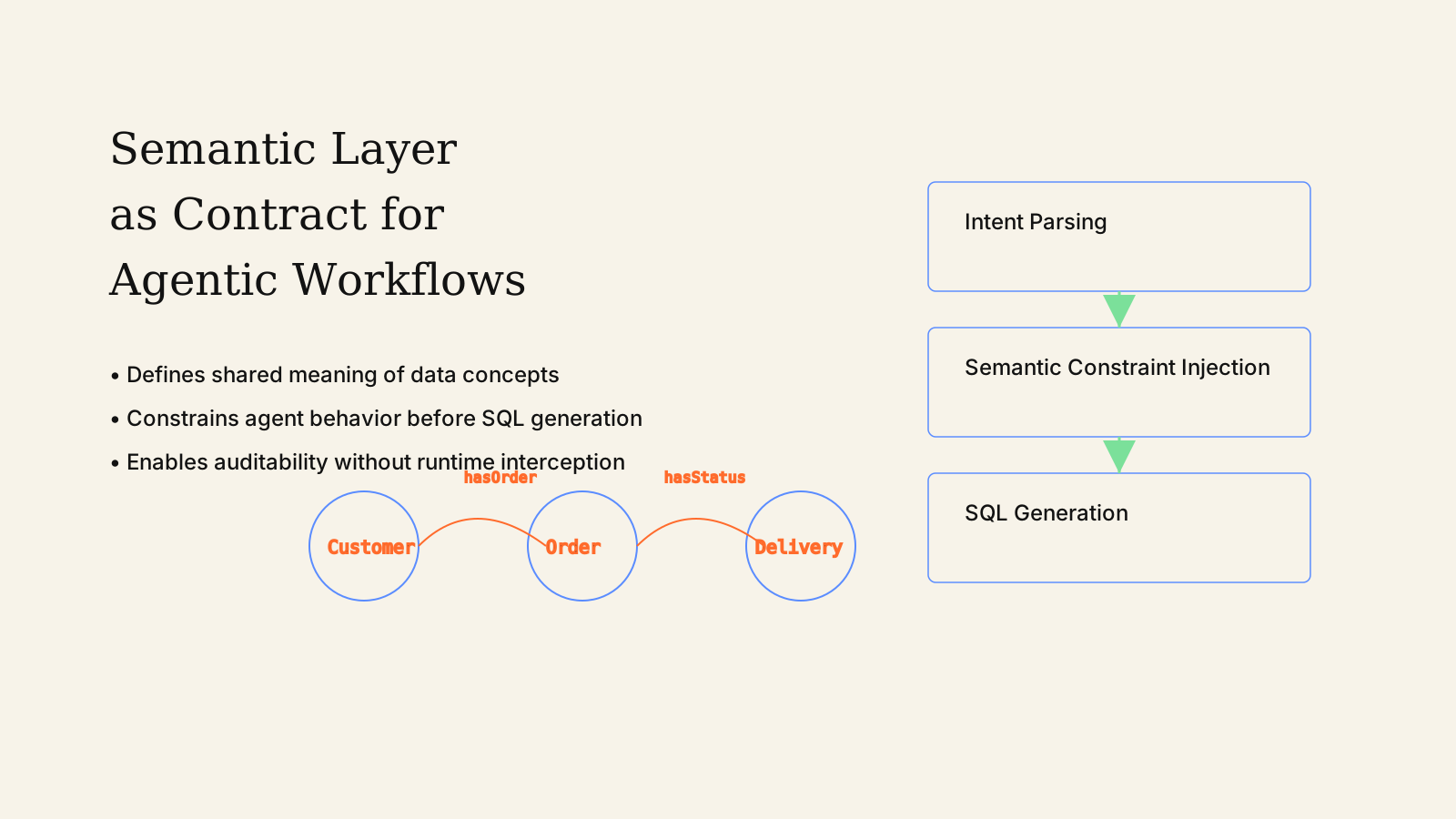
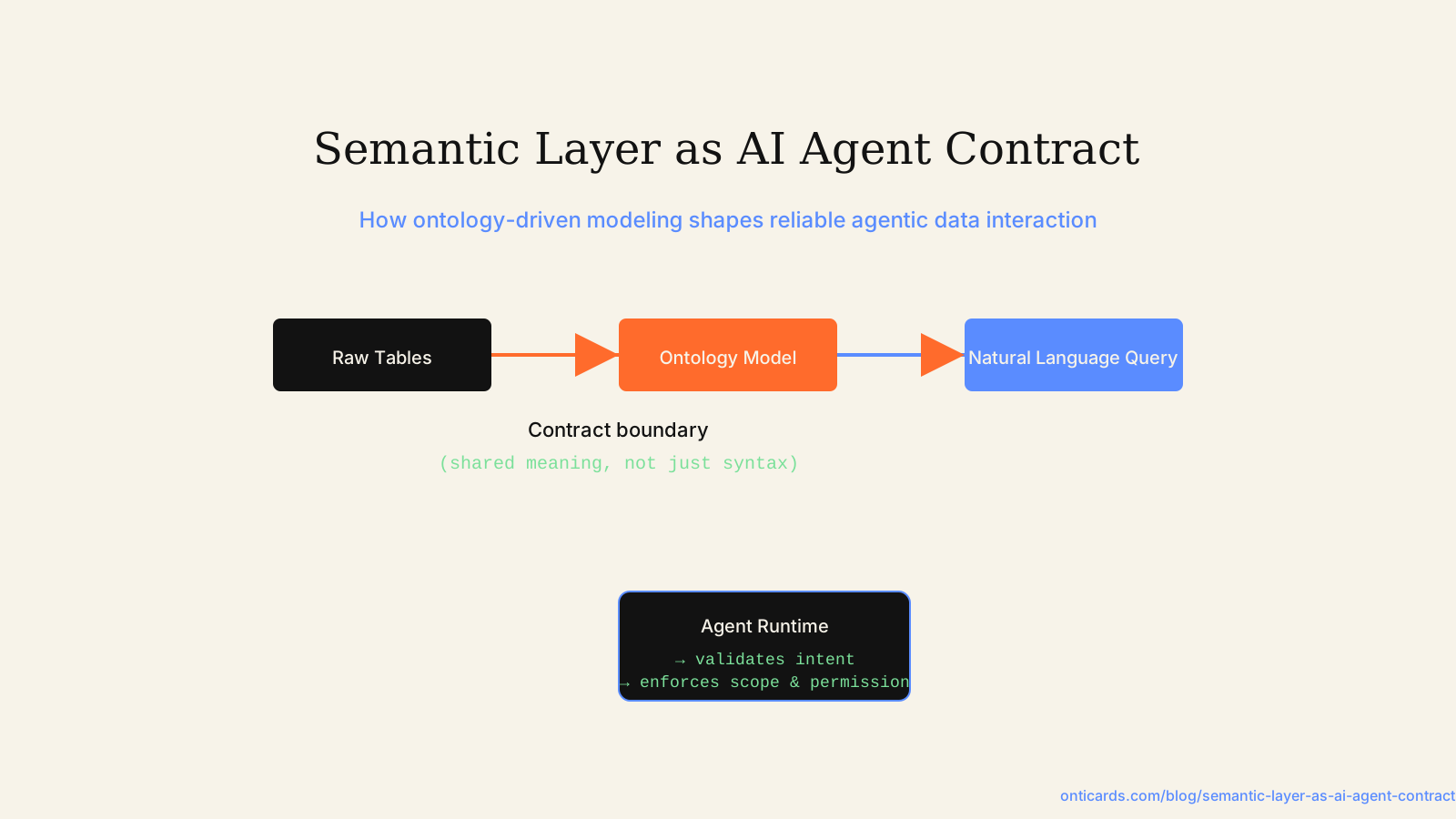
The biggest bottleneck in enterprise data intelligence isn’t model capability—it’s the lack of verifiable, auditable, and evolvable behavioral contracts for AI agents. The semantic layer fills this role uniquely: it doesn’t replace LLMs in generating SQL; instead, it provides structural constraints, permission context, and business-intent anchors—shifting NL2SQL from “best-effort” to “by-contract.”
The semantic layer is a contract—not a mapping table
Traditional data governance often reduces the semantic layer to a simple field-alias-and-definition lookup table. This works in static BI contexts but collapses under dynamic agent-driven querying. Why? Because agents don’t read documentation—they parse structure. They won’t understand “sales = order_amount − refund,” but they can verify whether revenue = order_amount − refund is formally declared as a computable relationship in the ontology.
A production-grade semantic layer must encode three kinds of contracts:
- Definition contracts: Ontological attributes, lifecycle rules, and identity uniqueness for entities like “customer”;
- Relationship contracts: Legitimate cross-domain associations (e.g., whether “production work order” may legally join with “financial payable”);
- Permission contracts: Field-level visibility and aggregation-level restrictions (e.g., regional sales managers see only city-level aggregates—not national averages).
These are not human-readable notes. They’re machine-processable statements—expressed in formal ontology languages like SHACL or domain-specific DSLs—and loaded by agents at runtime for validation.
NL2SQL success hinges less on LLMs, more on context injection quality
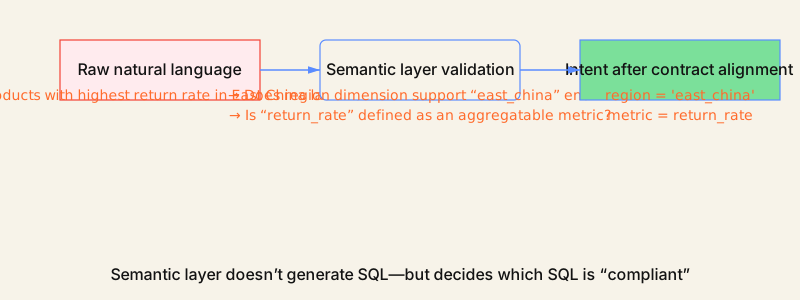
Many current NL2SQL efforts blame accuracy issues on model tuning or prompt engineering. In practice, failures occur most when natural language inputs are ambiguous (“top 3 products with highest return rate in East China last month”), cross-domain (“compare R&D headcount investment vs. product launch cycle”), or implicitly permissioned (“my department”). Prompts alone can’t reliably convey sufficient context.
What works is a layered context injection mechanism:
- Static layer: Ontology definitions (entity graphs, metric lineage, dimension hierarchies) precompiled into vector indexes for retrieval augmentation;
- Dynamic layer: Runtime injection of session-scoped metadata—user identity, organizational scope, temporal window preferences;
- Policy layer: Semantic-layer-driven rewrites (e.g., binding “recent” to “past 30 days” and verifying that granularity is supported in the target table).
The key tradeoff: sacrifice some generation flexibility to guarantee SQL output satisfies semantic-layer integrity constraints. This isn’t technical regression—it’s shifting uncertainty from execution time (uncontrollable) to modeling time (auditable, versioned, testable).
Data platforms and AI agents aren’t inherently compatible
Years of data platform investment haven’t automatically enabled robust agent deployment. The friction lies not in compute or storage—but in architectural contract misalignment:
- Platforms are built for batch ETL pipelines: throughput and scheduler stability matter most;
- Agents demand interactive inference: low-latency schema discoverability and real-time field-level permissions.
Common anti-patterns include:
- Treating the semantic layer as a downstream reporting service—forcing agents through multiple gateway hops, adding unpredictable latency;
- Hardcoding business logic in unified API layers—so agents remain blind to underlying schema changes (e.g., deprecation of a dimension table);
- Centralizing permissions at the API gateway, while nested subqueries generated by agents bypass field-level authorization.
A viable path is the lightweight semantic gateway: It doesn’t proxy all data access. Instead, it receives NL requests, validates semantic contracts, rewrites compliant SQL, injects permission predicates—and delegates execution to native platform engines. Decoupled from the platform, yet trusted by every agent.
In private deployments, ontology evolution matters more than model iteration
In trusted environments (e.g., government, finance), teams prioritize domestic models or OS compatibility (Kylin, UnionTech). But long-term operational entropy comes not from model updates—it arises from ontology drift: new KPIs added by business units, table schemas refactored by IT, or PII masking rules updated for compliance. When these changes aren’t synchronized into the semantic layer, agent behavior gradually degrades.
Thus, ontology management must support:
- Change observability: Every ontology edit (new dimension, revised metric formula) triggers a diff log and impact analysis;
- Version traceability: Semantic snapshots linked to agent query logs—enabling rapid root-cause diagnosis (was it model degradation—or ontology decay?);
- Collaborative convergence: Business users define terms via low-code interfaces; engineers validate implementations using DSLs—all within a shared ontology view.
This requires moving beyond “one-time modeling.” The ontology toolchain must be an infrastructure for continuous, collaborative evolution—far more consequential than any single model upgrade.
The semantic layer’s value lies in grounding AI agent “hallucination” in the enterprise’s actual business structure. It doesn’t promise higher accuracy—but ensures every error is attributable, fixable, and preventable. When the industry debates agent runtime isolation and auditability, the true starting point isn’t more telemetry—it’s ensuring the agent knows what it’s allowed to do.
References
- Chen, J., et al. (2023). Semantic Parsing for NL2SQL: A Survey of Challenges and Architectures. ACM Computing Surveys. https://doi.org/10.1145/3597503
- W3C SHACL Recommendation. https://www.w3.org/TR/shacl/
- The Data Mesh Principles (2021). Martin Fowler. https://martinfowler.com/articles/data-mesh-principles.html
- (No external references)