The Semantic Layer as Data Contract for AI Agents
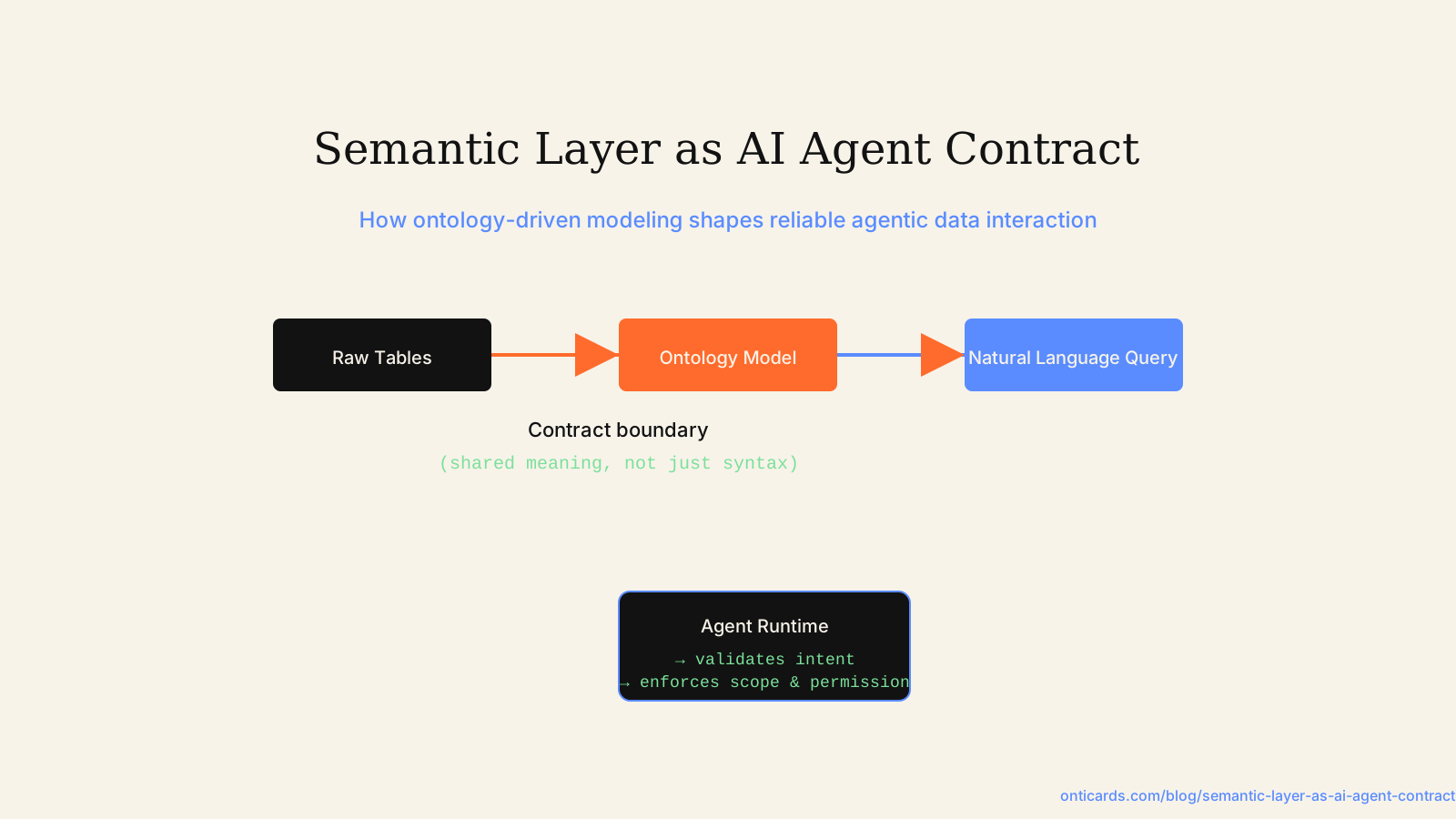
The semantic layer is not just a configuration layer for reporting tools—it's the formal contract between AI Agents and enterprise data systems. This article analyzes its threefold role: constraint interface, audit anchor, and collaboration protocol.
When enterprises adopt AI Agents for data tasks, NL2SQL models are often treated as universal keys—capable of unlocking any database if the model is large enough and fine-tuned frequently enough. But reality quickly delivers counterexamples: the same natural language query returns contradictory results across departmental Agents; after one deployment, the finance team’s “monthly revenue” unexpectedly includes unconfirmed orders; more insidiously, during an audit requiring traceability of a specific query, no verifiable semantic anchor exists in the execution chain.
The problem isn’t insufficient model capability—it’s the absence of a negotiable, auditable, and evolvable data contract mechanism. The semantic layer is that mechanism’s carrier—not an auxiliary configuration for reporting tools, nor decorative ontology for a data platform, but a formally ratified agreement between AI Agents and organizational data assets.
The semantic layer is first a constraint interface—not a translation cache
Most NL2SQL practices reduce the semantic layer to field alias mappings or dimension table descriptions. This works for single-hop queries—but reveals fundamental flaws once multi-hop reasoning, cross-source joins, or permission-sensitive paths enter the picture: it cannot express negative rules like “do not map sales order status to financial confirmation status.”
Effective semantic constraints require three layers of expressivity:
- Concept boundary definition: e.g., “Customer” means only legally registered, contractually active entities in CRM—explicitly excluding test accounts and historically deactivated records;
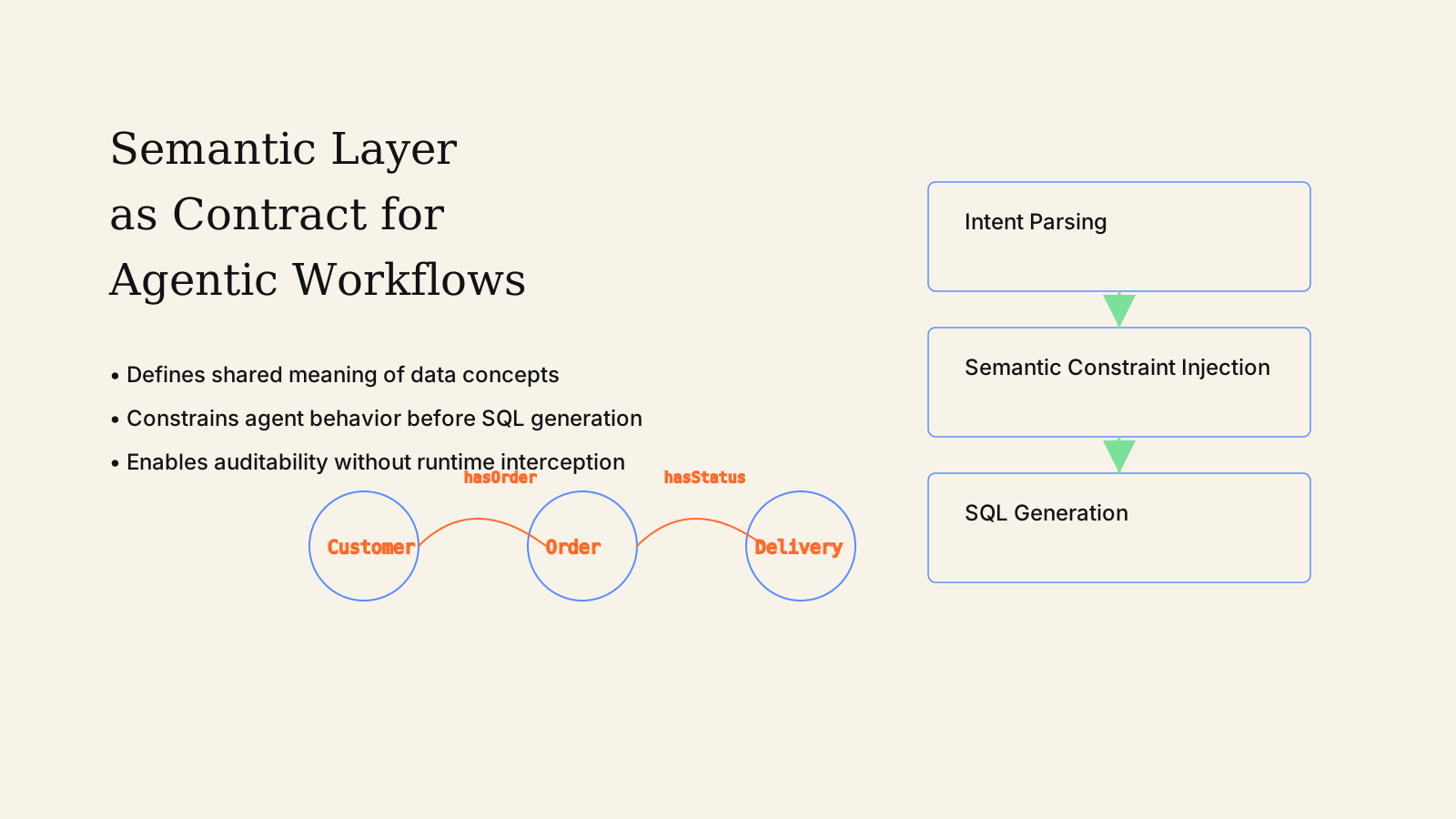
- Relationship validity declaration: e.g., “Order” may be linked to “Delivery Timeline” only when order status = “Shipped”;
- Negative guardrails: e.g., prohibit any Agent from directly using the “Advance Receipts” field in “Net Profit” calculations.
These cannot be implicitly learned from training data—they must be jointly signed as structured assertions by business stakeholders and data engineers. OntiCards’ experience shows that once the semantic layer hosts such explicit contracts, Agent SQL output stability ceases to depend on prompt engineering finesse and instead rests on the completeness of the contract itself.
It is an audit anchor—not a log snapshot
AI Agent auditability is often reduced to storing the “original query + generated SQL + execution result” triplet. This answers “what happened?” but not “why was it permitted?”
A truly auditable semantic layer inserts a non-bypassable validation step before every SQL generation: Is this Agent authorized to access the “Regional Sales Target” concept? Does the current context satisfy temporal constraints like “only after quarter-end close”? Are referenced metrics bound to the latest approved version?
The critical point is not interception—it’s evidence retention. All validation decisions bind to semantic concepts, forming a traceable policy evidence chain. For example, when a query is rejected, the audit report doesn’t say “insufficient permissions”—it states: “rejection triggered because ‘Sales Target’ concept is bound to policy v3.1, which requires operator=region_head, while caller identity is team_lead.”
This shifts auditing from post-event reconstruction to contractual compliance verification—significantly reducing cognitive load during root-cause analysis.
It is also a collaboration protocol—not technical documentation
The semantic layer is often treated as a one-way technical specification authored solely by data teams. A true contract, however, is bilateral: the data team commits to stable concept definitions and controlled changes; business units commit to never bypassing the semantic layer for ad-hoc analysis against raw tables; AI engineers commit to building all Agents exclusively atop semantic interfaces—not physical schemas.
We observe that successfully adopted teams implement lightweight semantic governance rhythms:
- Biweekly 45-minute “Contract Alignment Sessions,” focused on only 1–2 high-conflict concepts (e.g., “Active User”);
- Every new concept must ship with a minimal viable constraint (at least one positive definition + one negative rule);
- Semantic layer version upgrades automatically trigger Agent test suite reruns—failure blocks release.
This mechanism avoids perfectionism in modeling and emphasizes progressive enforceability. It transforms data governance from “does it exist?” into “who signed it, when did it take effect, and how is breach detected?”
Avoid two common anti-patterns
Two practices severely undermine the semantic layer’s contractual integrity:
- Downgrading it to a prompt template library: encoding “Revenue = SUM(sales_amount)” as interpolatable strings for LLMs. This bypasses constraint expression and severs links to permissions, versioning, and lifecycle management.
- Dynamically composing semantic logic at runtime: letting Agents stitch together field rules on-the-fly based on user roles. This appears flexible but destroys static verifiability—making it impossible during audit to determine which policy version governed a given generation.
The essence of a contract is predictable determinism. Dynamism belongs in contract version evolution—not in individual execution paths.
Conclusion: Contracts need signatures—and updates
The semantic layer’s value lies not in how elegant its ontology diagram looks, but whether it becomes a jointly ratified agreement among organizational roles. When AI Agents become routine entry points to enterprise data, the semantic layer acts as the silent, non-bypassable notary—accelerating nothing, yet preventing misinterpretation; replacing no model, yet defining its boundaries; guaranteeing no correctness, yet ensuring answers originate from a world defined by shared consensus.
This contractual mindset naturally aligns with OntiCards’ commitment to ontology-driven modeling: only formalized, inferable, versionable ontologies can bear organization-wide data contracts.
References
- Stonebraker, M., & Cetintemel, U. (2022). Data Management in the Age of AI. Communications of the ACM, 65(11), 76–84. https://doi.org/10.1145/3532797
- The Data Mesh Manifesto. (2021). https://datamesh.com/manifesto/
- Guo, Y., et al. (2023). Semantic Parsing with Constrained Decoding. ACL Anthology. https://aclanthology.org/2023.acl-long.412/
- This article draws on publicly available industry materials and the author’s practical experience.
(No external references)