Stop Drawing Your Ontology: Version It and Make It Portable
Ontology competition is no longer about nicer diagrams. Four gates decide whether your semantic layer survives: rebuildable, freezable, checkable, portable.
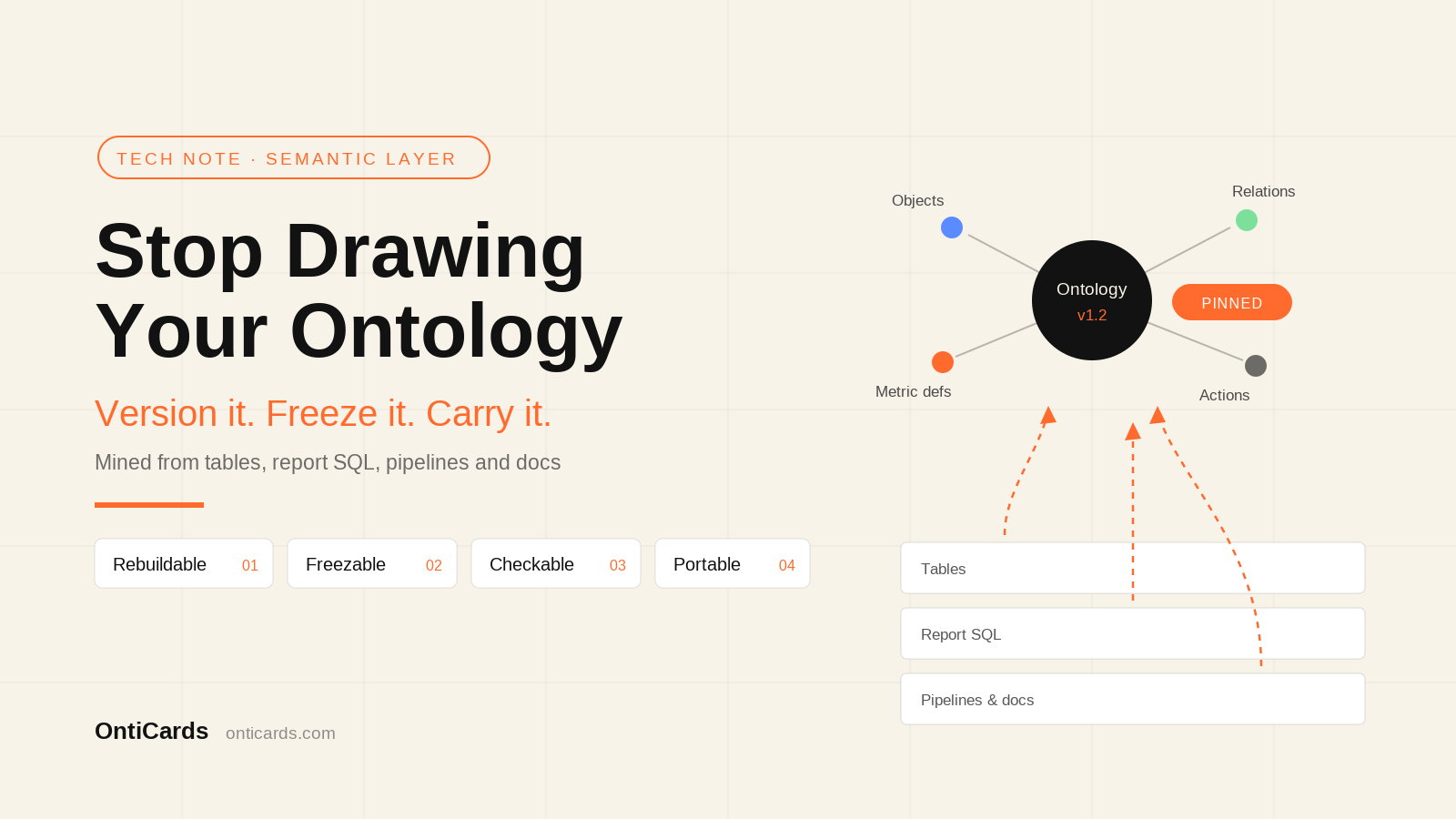
On November 24, OceanBase shipped an ontology platform called Ontos. The same week, analysts took apart Collate's Ontology Studio. The two companies are not building the same product, but they are answering the same question: how does an enterprise ontology actually get built? Neither answer is "draw boxes on a whiteboard, left to right." Both are closer to: mine it out of the systems you already run, then get a human to sign off, line by line.
That's worth a post of its own. For two years the industry has talked about semantic layers far more than it has built them.
1. Ontology just moved from "modeling project" to "construction job"
Start with what actually happened.
At its AI Data Conference, OceanBase launched OceanLake, a combined lake-and-database AI data platform; open-sourced its core AI database OceanSeek; introduced Ontos, an enterprise "agentic ontology" platform; and released a cloud version of DataPilot for business users. CTO Yang Chuanhui's description of Ontos is short. The ontology here is a business relationship graph: customers, policies, products, claims on the graph, plus the relationships between them, the definitions of metrics, and which roles are allowed to perform which actions.
The same week, Collate drew a hard line between an ontology and a glossary. A glossary is written for people — at best it adds directional links like "a customer buys a product." An ontology is written for machines as well as people: every business concept is a class with its own properties, an inheritance chain, and validation rules, and each concept binds to a whole table rather than a single column. The model is then exposed to agents over MCP.
Two same-day stories look unrelated but aren't. Zipher came out of stealth with $53 million, arguing that agents should decide how enterprise data workloads run. Huawei Cloud opened a partner program around its AgentArts platform, saying it already serves more than 1,000 enterprises and has accumulated over 6,000 agent assets spanning models, datasets, and skills.
Put those together and the pattern is hard to miss: nobody is arguing about whether ontologies matter anymore. They're working out how to build one and how to hand it over. The concept phase is over. The construction phase has started.
| Signal (around Nov 24, 2026) | What shipped | What it says about construction |
|---|---|---|
| OceanBase | OceanLake, open-source OceanSeek, Ontos, DataPilot | Ontologies get extracted from existing tables, report SQL, pipelines and documents, then validated by domain experts |
| Collate | Ontology Studio (in Collate 2.1) | Concepts are classes; the published release is pinned for agents; the model can be exported |
| Zipher | $53M raise | Agents take over workload scheduling; the data stack itself starts being run by agents |
| Huawei Cloud | AgentArts partner program | Agent assets (models, datasets, skills) start being managed as inventory |
2. Gate one: ontologies get mined, not drawn
OceanBase's approach is unusually concrete. The tables, report SQL, data pipelines, and documents an enterprise has already accumulated contain a large number of modeling clues. The platform extracts relationships from those assets first, then asks domain experts to fill gaps and validate.
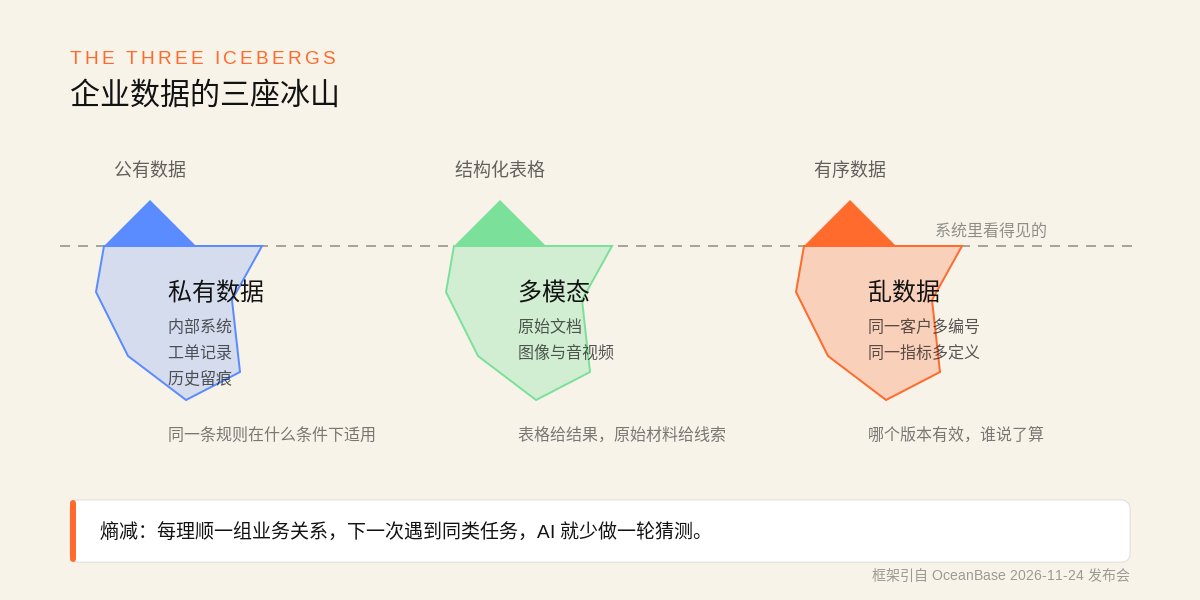
Why is that order more reliable than workshop-based modeling? At the conference, CEO Yang Bing described the enterprise data that actually determines AI performance as three icebergs. The first is the line between public and private data: the operating detail that matters lives in internal systems, tickets, and historical records — the places that capture under what conditions a rule applies, why a metric's definition changed, and how a specific business exception was handled at the time.
Those are precisely the things humans forget and systems remember. Put a domain expert in a room and they can tell you the current rule. They usually cannot tell you why that rule changed in March 2024, because the email that triggered the change isn't in their head — it's in the ticketing system.
So the first deliverable of an ontology project should not be a beautiful diagram. It should be a list with provenance: for every object, metric, relationship, and permitted action, which table, which SQL, which pipeline, which document it came from, and who confirmed it. Anything without provenance gets marked "unresolved" — don't rush it onto the canvas.
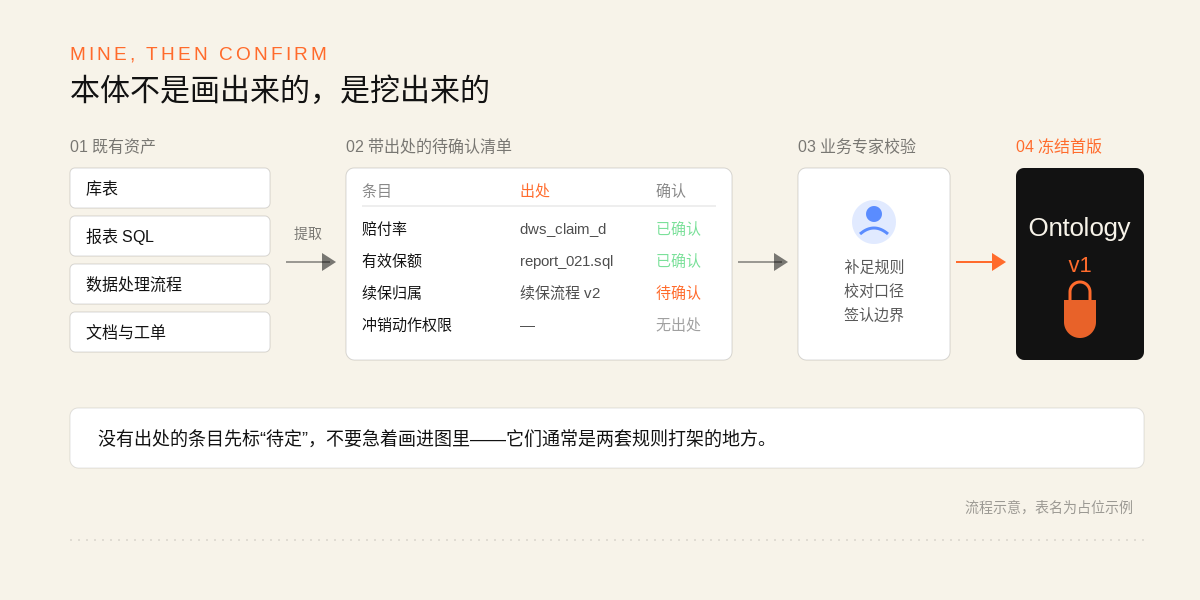
This is the same root cause behind why semantic layers decay. Rules maintained by hand start drifting the moment the person maintaining them leaves. Rules with provenance can be traced when they drift — to the specific definition, the specific table that changed. A mined ontology is structurally more decay-resistant than a drawn one.
3. Gate two: agents need a frozen release, not a live draft
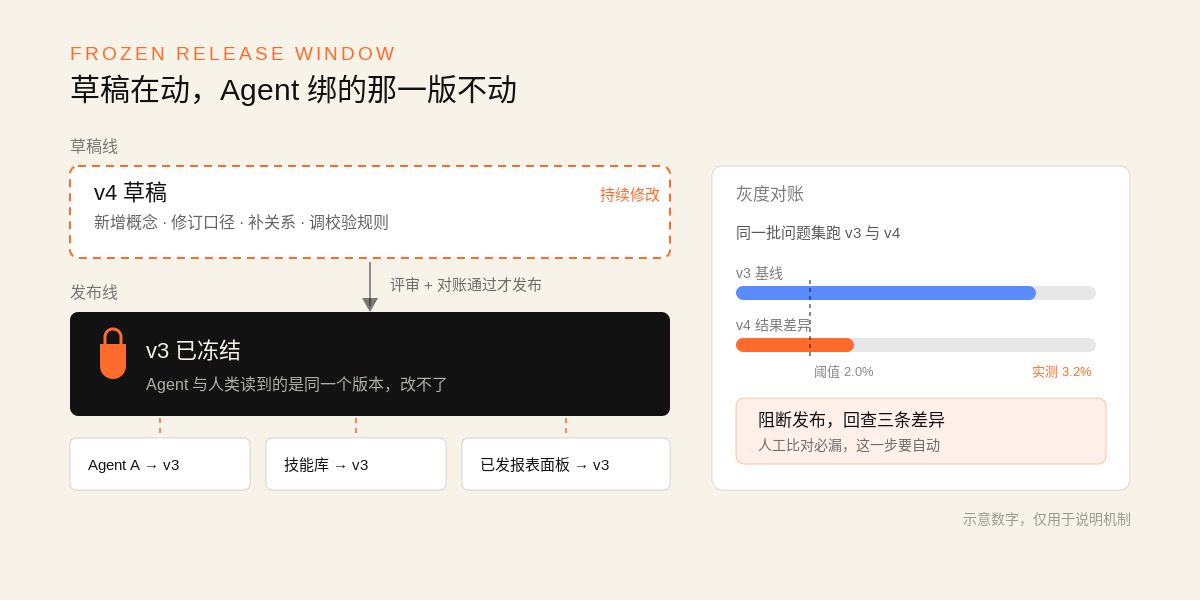
One detail in Collate's design is easy to skim past as a feature bullet, but it's load-bearing: the published version stays fixed for agents and humans, while the team keeps working on the next draft.
Microsoft is running the same logic. At FabCon Europe 2026, Fabric IQ serves as a shared semantic layer, bringing together OneLake data, trusted metrics from Power BI semantic models, ontologies, and real-time intelligence. With Fabric IQ MCP now generally available, compatible agents and applications reach governed semantic models while respecting existing security and governance controls.
Why is freezing a hard requirement rather than fussiness?
Because an agent isn't a one-shot query. It's a long-running process with checkpoints, retries, and resume points, and its prompts, skills, and code hard-code field names, definitional assumptions, and entity boundaries. Change the ontology underneath and the agent does not throw an exception. It computes a number using the new definition — a number that looks entirely reasonable — and nobody downstream knows it can't be compared with last week's.
In classic BI, this problem was absorbed by humans adapting: the definition changed, the analyst knew, someone added a note to the dashboard, and it came up in the weekly meeting. Agents don't read the notes.
So versioning isn't a tag you slap on. It has to be a mechanism that stops incidents. Four things, minimum:
- A contract version. The ontology has an explicit release number. Every agent declares which release it binds to at registration. No implicit "always follow latest."
- Blast-radius checks. Before a metric definition changes, you must be able to answer who consumes it: which agents, which skills, which already-published reports.
- Parallel runs with diff reconciliation. Run the same question set against both versions; block the release when divergence crosses a threshold. This has to be automated — eyeballing it will miss things.
- A real deprecation window. Old releases get an end-of-life date. "Permanently backward compatible" always degrades into "permanently ambiguous."
4. Gate three: what you audit isn't the number
Collate exposes four graph tools over MCP: ontology_describe, sparql_query, entity_neighborhood, and find_by_tag. Per its own documentation, an agent can look up a concept and its properties in one call, follow the graph to the tables that implement it along with their owners and data quality — and show the query behind its answer so a person can check it.
The value here isn't "more endpoints." It's that the audit layer moves up one level. We've written before about checkable text-to-SQL, where you audit whether the SQL is right. Here you audit who defined the metric, in which release, bound to which table. The first is technical correctness. The second is business correctness — and a syntactically perfect, internally consistent SQL statement can absolutely produce a number that finance refuses to sign.
There's an engineering payoff too: one SPARQL query can return the concept, its relationships, and the backing tables in a single hop, replacing four round trips (find metric, get definition, find table, check quality). That saves tokens and latency. What actually matters is that every step of the answer is a recorded edge, which means the answer can be reconstructed after the fact.
One trap worth naming: surfacing the query is not the same as making it legible. Nobody in finance should be reading SPARQL. They should read one sentence — "this figure comes from the finance-owned revenue concept at v3, bound to the orders table, definition changed 2026-11-01." The tool does the first half. The product has to do the second.
5. Gate four: if you can't take it with you, it isn't an asset
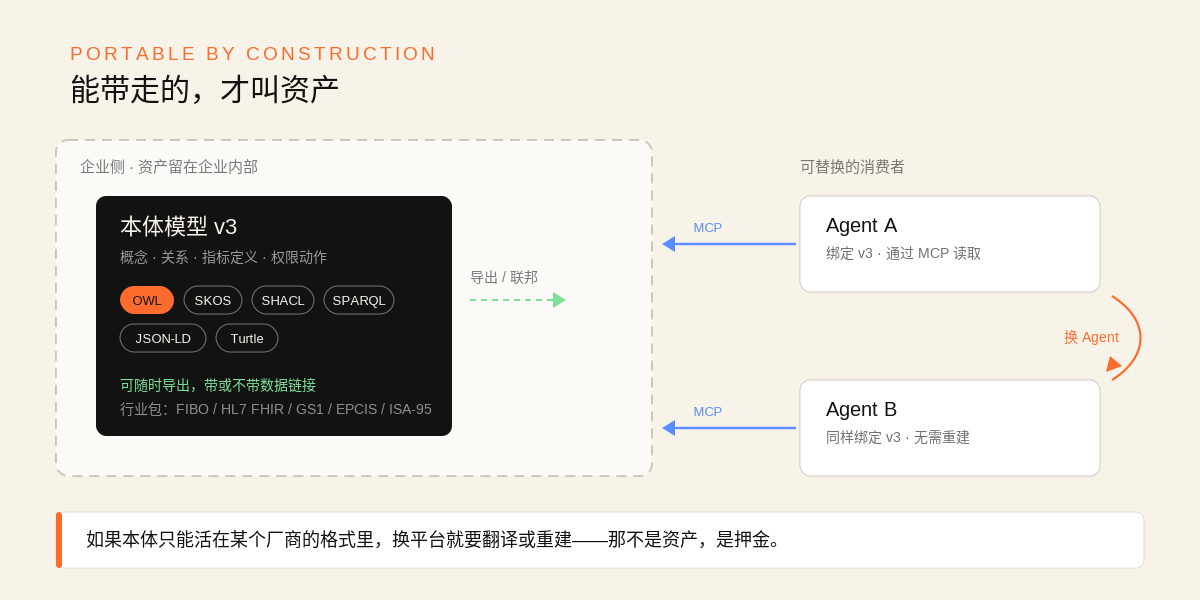
Collate's other bet is on W3C standards: OWL, SKOS, JSON-LD, Turtle, SPARQL, and SHACL, with import from OWL/SKOS/JSON-LD/Turtle/CSV and export at any time — with or without the links to your data. It also ships prebuilt industry packs: FIBO for finance, HL7 FHIR for healthcare, GS1 for retail, EPCIS for supply chain, ISA-95 for manufacturing, and HR Open for HR.
Futurum's analysis lands a sharp counterpoint here: the context layers from the hyperscalers — Databricks Genie Ontology, Snowflake Cortex, AWS Context Service, Microsoft Fabric IQ Graph — are largely metadata abstractions built over their own warehouse tables. Cross-platform semantic portability is left unaddressed.
For a buyer, that's a very useful procurement question. If your ontology can only live inside one vendor's format, changing platforms means translating or rebuilding it. Then it isn't an asset. It's a deposit.
Portability is testable in an afternoon, no slideware required: ask the vendor to export the model as OWL plus SHACL, parse it with an open-source tool, and run the validation rules. If it won't come out, it wasn't there.
6. Four gates, one checklist
Here's the whole argument on one page. Left column is the property, middle is what breaks without it, right is a check you can run today. Notice the right column needs no new procurement.
| Property | What breaks without it | How to check (same day) |
|---|---|---|
| Rebuildable | The ontology becomes meeting minutes, permanently out of sync with the rules the systems actually run | Sample 20 metrics that agents reference and name the provenance of each: table, SQL, pipeline, or document |
| Freezable | Definition changes propagate silently; figures stop being comparable week to week and nobody is alerted | Change one metric definition and watch whether the release is blocked and affected agents are listed automatically |
| Checkable | Wrong answers can't be explained, only re-run | Pick any answer and try to reconstruct the trio: concept release, backing table, owner |
| Portable | Platform migration forces a rebuild; business logic is locked in | Export OWL/SHACL, parse with a third-party tool, run the validation rules |
If two of those four rows fail, you don't have a semantic layer yet. You have a demo.
7. The counter-argument: don't build a third codebase
After all that advocacy for versions, standards, and validation, the honest caveat: it all costs something, and the cost bites back.
The worst outcome we've seen is a semantic layer that nobody dares touch. Every change "affects 80 downstream consumers," so changes queue for review, the business gets tired of waiting, someone writes their own SQL, and the semantic layer loses its authority entirely.
The fix isn't less governance. It's minimum sufficient scope. Define only what actually gets asked about, and four categories are enough: objects, relationships, metric definitions, and permitted actions — which happens to be exactly how OceanBase describes the four things on its graph. Don't build the whole industry's ontology for the sake of completeness. That's a standards body's job, not a first-year priority for an enterprise.
Collate has a genuinely useful inverse metric for this called ontology health: it surfaces concepts with no relationships or no data bindings. A class with no bound data is usually a class nobody asks about. Those are the ones to delete, not the ones to complete.
The order that works: mine the 20 most-asked-about concepts, freeze v1, put agents on it for real, then let the questions you can't answer drive v2. Do it backwards and you build a library nobody enters.
8. Closing
Read together, the four signals from that one day say a single thing. Ontology competition is no longer about whose graph looks better. It's about who can mine it out of existing systems, freeze it into releases, lay it open for inspection, and let you carry it away.
That's also why the ontology layer sits in the middle of our four-layer architecture: data cards carry objects and provenance, the ontology semantic layer carries the contract release, the skill library carries actions, and the agent ecosystem consumes all of it. The two most underrated pieces on that chain are provenance and version numbers. Neither produces a demo moment. Both decide whether the system still works in month three. If you want to see how the layering maps onto real scenarios, start with the product overview, or look at the query paths for your industry under solutions.
And if your semantic layer has no version number yet, don't wait for a platform upgrade. Pick 20 high-frequency concepts and write down where each one comes from. That's an afternoon's work, and it's the part that compounds.
References
- 科技行者, "在离线融合、湖库一体,OceanBase 造了一个 Agent 友好数据平台", 2026-11-24 — https://news.qq.com/rain/a/20261124A0C71B00
- Collate, "Ontology Studio: Business Meaning for AI Agents", 2026-11-17 — https://www.getcollate.io/blog/ontology-studio-business-meaning-for-ai-agents
- Futurum Group, "Collate Ontology Studio Closes the AI Agent Context Gap", 2026-11-24 — https://futurumgroup.com/insights/collate-ontology-studio-closes-the-ai-agent-context-gap/
- DataArt, "FabCon Europe 2026: From Unified Data to Business Context and Agentic AI" — https://www.dataart.com/blog/insights-from-fabcon-europe-2026
- Tested Intelligence, "Zipher Raises $53 Million to Put AI Agents in Charge of Enterprise Data Workloads", 2026-11-24 — https://testedintelligence.com/ziphers-53m-agents-run-data-workloads
- 新华财经, "华为云智能体首批伙伴亮相 多家上海 AI 企业加入", 2026-11-24 — https://m.10jqka.com.cn/20261124/c682171792.shtml