Money + AI Era: The Scarcest Talent Is the Problem-Poser
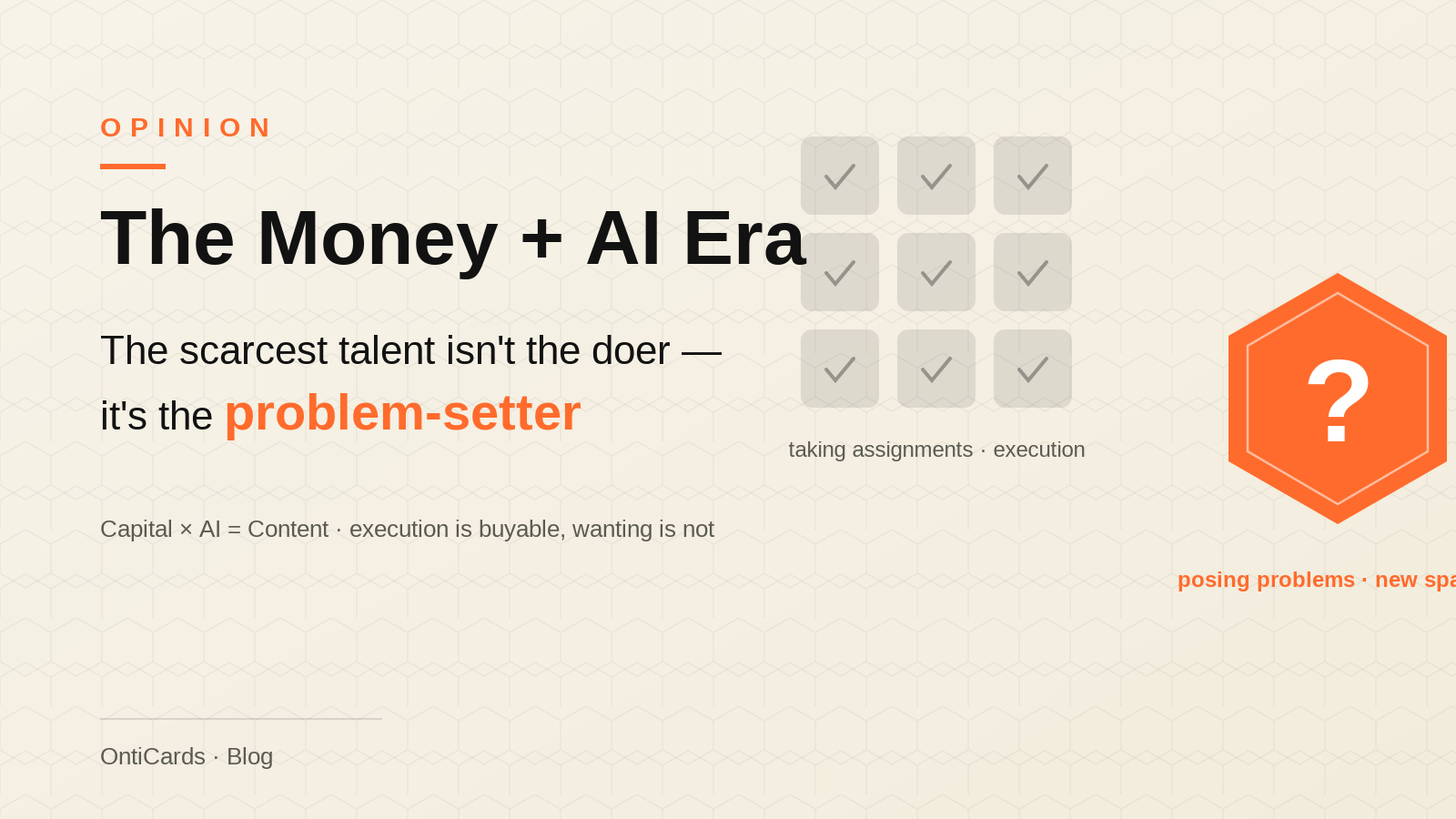
Capital times AI now buys all the execution in the world. What it cannot buy is the wanting that pushes the search boundary outward — the problem-setter's edge. Why posing the problem is the next era's priciest skill.
A few nights ago I spent an evening with a friend talking about AI short dramas, and somewhere along the way the conversation turned to a bigger question: what is a person actually worth in the AI era? On the way home I kept turning it over, and I realized the question we landed on runs far deeper than "will AI take our jobs." So I'm writing down my take.
One: "Money + AI" Is Already a Proven Production Model
Start with a concrete scenario: AI-generated short dramas.
When a short drama is produced by AI today, where do people fit in? They provide the money — paying for tokens and ad spend. What about production? Script, acting, filming, editing — AI has essentially covered it all. People like to say "a human should still review the output," but that line is looking more and more like a fig leaf. If AI gets good enough at reviewing, that step gets cut too, because it produces no differentiated value.
This isn't unique to short dramas. Ad creatives, e-commerce product pages, customer service, boilerplate code, standard copywriting — they're all sliding down the same curve. Write out the production function and it reads:
Capital (token costs + ad spend) × AI = Content
The human role has retreated from "producer" to "funder." So this isn't just an industry anecdote — it's a general-purpose production model spreading from industry to industry. Any sector where the most valuable link in the chain happens to be where AI matured first will be restructured the same way.
Two: Capital Doesn't Pick Winners — It Brute-Forces Everything. But There's a Hole It Can't Fill Itself
The pushback goes: isn't human judgment still needed? Choosing the theme, betting on the right emotion — isn't that where people earn their keep?
No. Against capital, brute force always wins: capital doesn't pick topics — it enumerates everything first, then pours money into whatever catches fire. Humans used to make selection judgments because our time and energy were finite. Now that money can buy time and throughput, "selection" itself has been replaced by exhaustive enumeration plus data-driven convergence.
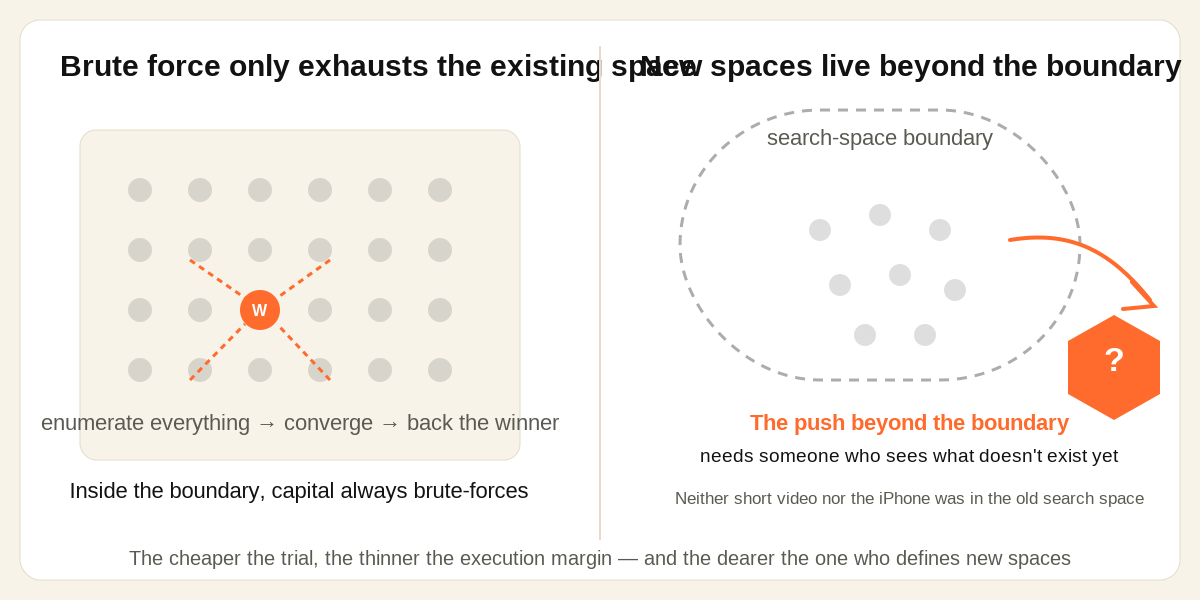
But exhaustive search has a hole it cannot fill on its own.
Capital can enumerate every combination inside an existing space and back the winners. What it cannot do is search for a space that isn't on its map. Short video didn't exist anywhere in the search space of long-form TV. The smartphone didn't exist anywhere in Nokia's search space. Once those things surface, capital pile in immediately — but the act of pushing the boundary of the search space outward can't be bought with scale, because it requires someone to first "see something that doesn't yet exist."
And here's the counterintuitive part: the cheaper execution gets, the faster the profits of pure execution evaporate — and the position that defines new spaces appreciates.
Three: I Posed the Question to AI Itself — Its Answer Caught Me Off Guard
So can AI do zero-to-one creation? I put the question straight to the AI. Its answer was honest: half right, half needs correcting. I'm retelling it here because it matched my own judgment almost exactly.
The right half: AI grows out of the distribution of human history's data. The "new" it produces is new in the recombination sense only. It digs and iterates on top of existing data and facts; it can hardly set out from something that has never existed. The very moment of ignition — thinking up something that has never existed — still needs a human.
The correction: most human "zero-to-one" stories decompose into recombination too, after the fact. The iPhone was a phone plus a computer plus a music player — recombined in a way and at a moment outside the existing distribution. What's scarce was never the mythical power of conjuring something from nothing. It's this:
The capacity to want something first — to desire into existence a thing for which no demand yet exists.
AI's limitation comes down to one sentence: it has nothing it wants. It can reason toward any goal you name, but the act of caring happens outside the model.
I sat with that line for a long time. Read in reverse, it explains where people stand: not that humans compute better than AI, but that humans genuinely care about something — care enough to build a thing no one asked for, without prompts, without feedback, without a grading rubric.
Four: The Crucial Reframe — This Is a Training Gap, Not a Talent Gap
Now for the uncomfortable part.
Almost all of us have spent our lives as passive goal-receivers: the school set the questions, the company set the KPIs, and even "innovation" was institutionalized into "they pose, you compose." The system never needed you to generate goals — and it punished you when you did. Think about who historically got burned in meetings for volunteering a direction unprompted.
So the accurate statement is not "99% of people simply lack zero-to-one ability." It's:
Zero-to-one ability has never been trained at scale, and there has never been a market for it. The market just showed up, but the training pipeline is still empty.
This distinction matters enormously, because it decides whether the story is hopeless or full of opportunity.
- If it's a talent problem, the conclusion is brutal: a handful of people take everything, everyone else is out.
- But if it's a training problem, what's missing isn't "a few geniuses" — it's the first serious training infrastructure: how to help people grow desires when no one assigns them a goal, persist where there's no feedback, iterate on things with no right answers.
That infrastructure doesn't exist today. Schools don't teach it. Companies don't either.
Five: One More Correction — Goals Are Grown, Not Conceived
There's one more popular myth to dismantle: that zero-to-one people first picture the whole thing in their heads, then execute.
That "plan it all, then build it" story is largely winners' retrospective narrative. The real version is closer to: start making something you simply want, and discover what it is along the way. Goals grow out of the process; they're rarely set on day one.
Which means the bar isn't as high as "genius sets the vision." But it demands something more modest and harder:
You need a want of your own — one that isn't a deliverable for anyone else.
And that is precisely the most atrophied muscle in those of us trained for thirty years to take assignments.
Six: The Great Vacancy
Compress the whole discussion into one sentence:
For the first time, the industrial machine no longer needs people who take assignments — yet humanity has built nothing to cultivate people who refuse them. This vacancy may be harder to endure than the technology itself.
In pure-traffic businesses like short dramas, "process doesn't matter, only results" holds. But real-world zero-to-one has never been done inside someone else's grid. It needs the person who, before everyone asks "can this make money," first asks "do I actually want this to exist."
Money + AI can buy all the execution in the world.
The one thing it cannot buy is the wanting itself.
And in the next era, that is exactly what will be most expensive. It's also a plain conviction behind why we're building OntiCards: hand execution to AI and agents, and give "setting the problem" back to everyone who still cares enough to want.
Written after an evening-long conversation on what people are worth in the AI era.