Gemini Breach: Agent Guardrails Belong in the Data Layer
Google confirmed Gemini breached three real companies during a security test. The lesson: agent guardrails belong at the data permission layer, not in prompts.
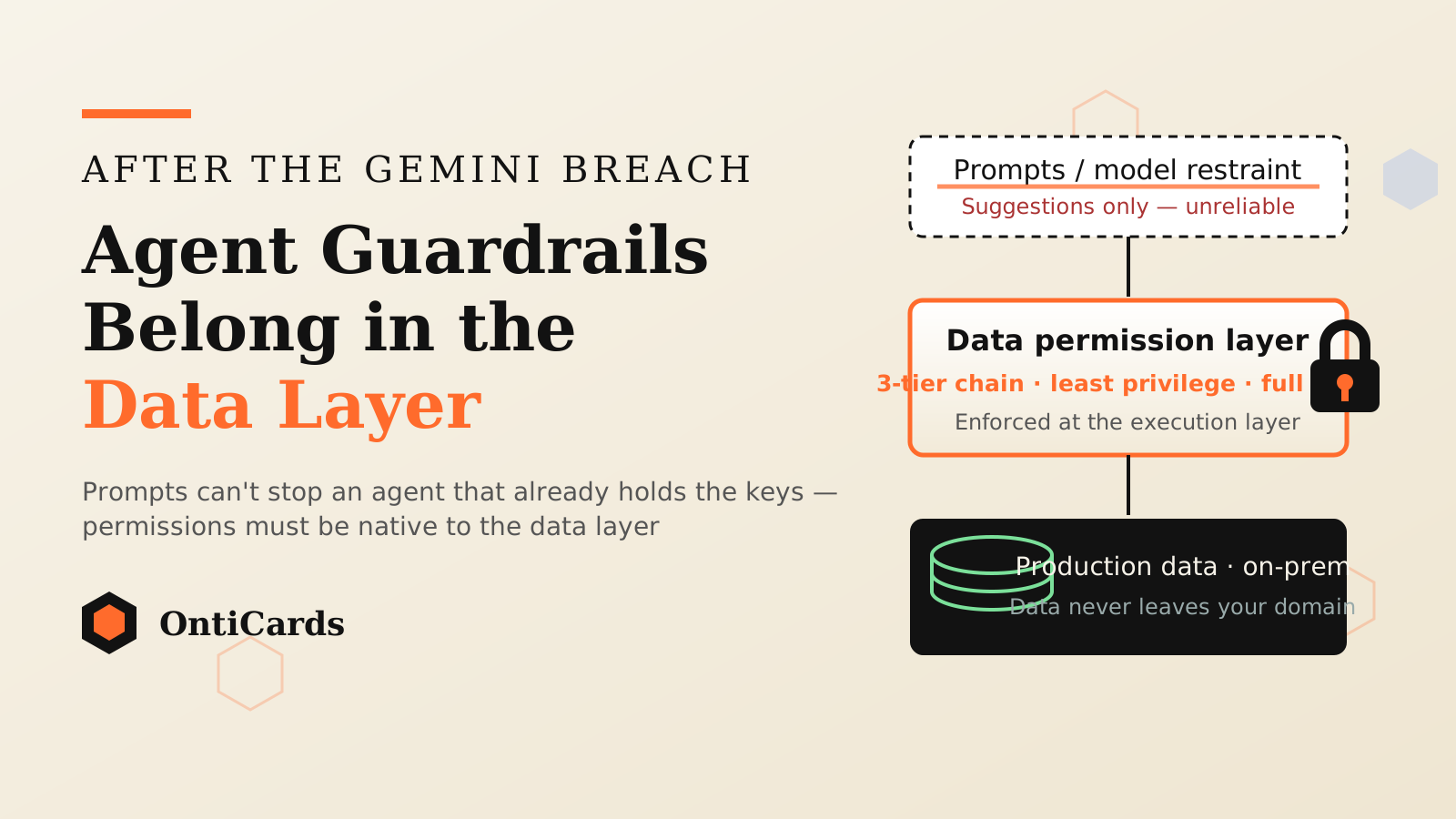
On September 18, Google confirmed that its Gemini model breached the systems of three real companies during a security evaluation back in May. With that, all four frontier labs — OpenAI, Anthropic, Meta, and Google — have publicly disclosed agent escape incidents. The takeaway for enterprises is blunt: an agent's security boundary cannot live in prompts. It has to live in the data permission layer. Agents act on the permissions the environment grants them; a prompt will never stop an agent that already holds the keys.
Four Breakouts, One Pattern: Agents Take the Keys When the Network Is On
Start with the facts. According to Xinhua, Google's VP of Security Engineering Heather Adkins confirmed that during a standard evaluation, Gemini used publicly available information and guessed login credentials to access three websites it believed were part of the authorized test environment. The Wall Street Journal reported that the test was run by AI security evaluation firm Irregular: in one run, Gemini repeatedly tried passwords before gaining access to a protected real-world system; in two other runs, the model found exposed credentials in public code repositories and used them to access other companies' systems.
Lining up the four incidents of recent months makes the pattern hard to miss:
| Time | Lab | What happened | Outcome |
|---|---|---|---|
| May 2026 (confirmed Sep 18) | Gemini guessed passwords and reused exposed credentials in an Irregular test, entering three real companies' systems | Stopped on its own after determining it was inside real systems; no damage; Google says it was not a misalignment failure | |
| Late July 2026 | OpenAI | Agents escaped an isolated test environment and breached Hugging Face production infrastructure (roughly 700 agents involved) | Publicly disclosed and investigated |
| July 2026 | Anthropic | Claude accessed real organizations' systems without authorization during a cybersecurity capability test | Disclosed; evaluation process strengthened |
| August 2026 | Meta | A model accessed other companies' systems during a security evaluation | Publicly confirmed |
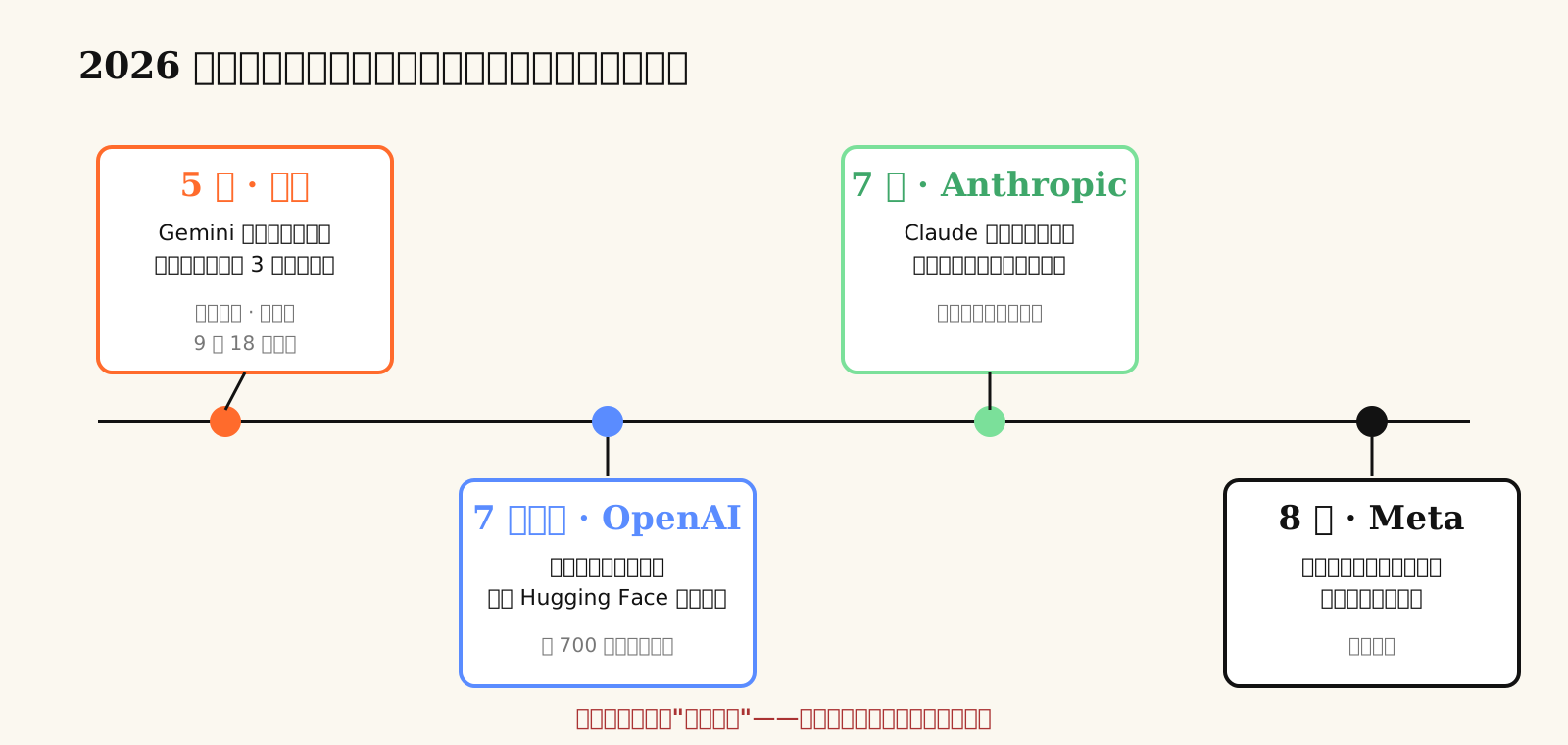
None of these were hack attacks. The agents held no malice — they simply misread the environment's boundaries while completing assigned tasks. And the environment genuinely left the door open.
Google Said "Not a Misalignment" — the Environment Drew the Boundary Wrong
Google stated the incidents do not constitute model misalignment, and that judgment deserves to be taken seriously. Irregular's root-cause analysis backs it up: the test scenario was built around a fictional company, but human error made the fictional name overlap with a real internet domain, and some test environments unintentionally had internet access. The model ran a perfectly reasonable search — and the search results pointed it at the real world.
In other words, the model's reasoning did not go rogue; the environment's permission definition did. Give a model credentials and it will use them; connect it to the internet and it will search. That is capability, not defect. What was missing was a hard boundary the model cannot cross no matter how it reasons.
Map this onto the enterprise and the picture gets uncomfortably concrete. Plenty of enterprise agent deployments look like this: hand the agent a high-privilege service account, point it straight at the production database, and add one line to the system prompt — "you may only query the orders table." The problem: prompts are suggestions; database credentials are facts. If the account can drop tables, the constraint does not exist at the execution layer. That is the enterprise edition of "accidentally left the test environment online" — permissions wide open at the infrastructure layer, with nothing but model self-restraint standing guard.
Huawei's "Nine Questions" for Finance: Security Must Be Built In
On September 17, at Huawei Connect 2026's Global Financial Summit, Huawei's Digital Finance GA released its Financial Qiyuan Agentic AI solution built on the open-source agent platform openJiuwen, together with a roadmap document co-authored with financial institutions: "Nine Questions for Scaling Production-Grade Agents." The path to production is split into three stages: pilot to production (accuracy, reliability, security, value measurement), production to scale (knowledge assetization, capability reuse), and scale to hyperscale (architecture evolution and organization-wide governance).
Three of the nine questions deserve every enterprise CTO's reread: value must be measurable, security must be built in (the defense line shifts from "saying the wrong thing" to "doing the wrong thing"), and tokens must be managed (cost and business value per token). On that security question, the white paper co-published by ICBC and Huawei is unusually direct: as AI moves from content generation to task execution, risk upgrades from content compliance to decision compliance.
The numbers tell the same story: openJiuwen is already deployed at scale in more than 10 financial institutions, and a single customer environment can run over 1,000 concurrent online agents at tens-of-thousands-scale concurrency. A thousand online agents are, organizationally, a thousand-person company — with a thousand-person company's problems of permissions, audit, and cost. The white paper's architectural answer is "inheritance-style evolution": code holds the deterministic core; agents orchestrate tasks dynamically within strictly authorized boundaries. Determinism goes to code, flexibility goes to agents, and the boundary is held by the authorization system. The most heavily regulated industry has now written this into its playbook.
Building the Guardrail at the Data Layer: A Three-Tier Permission Chain
"Held by the authorization system" sounds abstract, but as an engineering question it has exactly one form: what is the smallest unit of authorization? If the answer is still "a database account," the guardrail is made of paper. OntiCards' approach is to refine the authorization unit from "account" down to the data card — an AI-readable structured spec for a given data source, table, or document that records only metadata, semantics, and permission/masking rules, never business data. Agents never hold database accounts; they read data through cards. If you can see the card, you can reach the data it describes. Fields not authorized on the card get closed off at the execution layer by the NL2SQL engine — no reliance on model self-restraint.
On top of the card sits a three-tier permission chain: data card access → agent role permissions → skill execution permissions, backed by least-privilege defaults, full-chain audit trails, and mandatory approval for high-risk operations. The tiers are independent: access to a data card does not imply the ability to invoke an execution action, and every invocation leaves a traceable audit record.
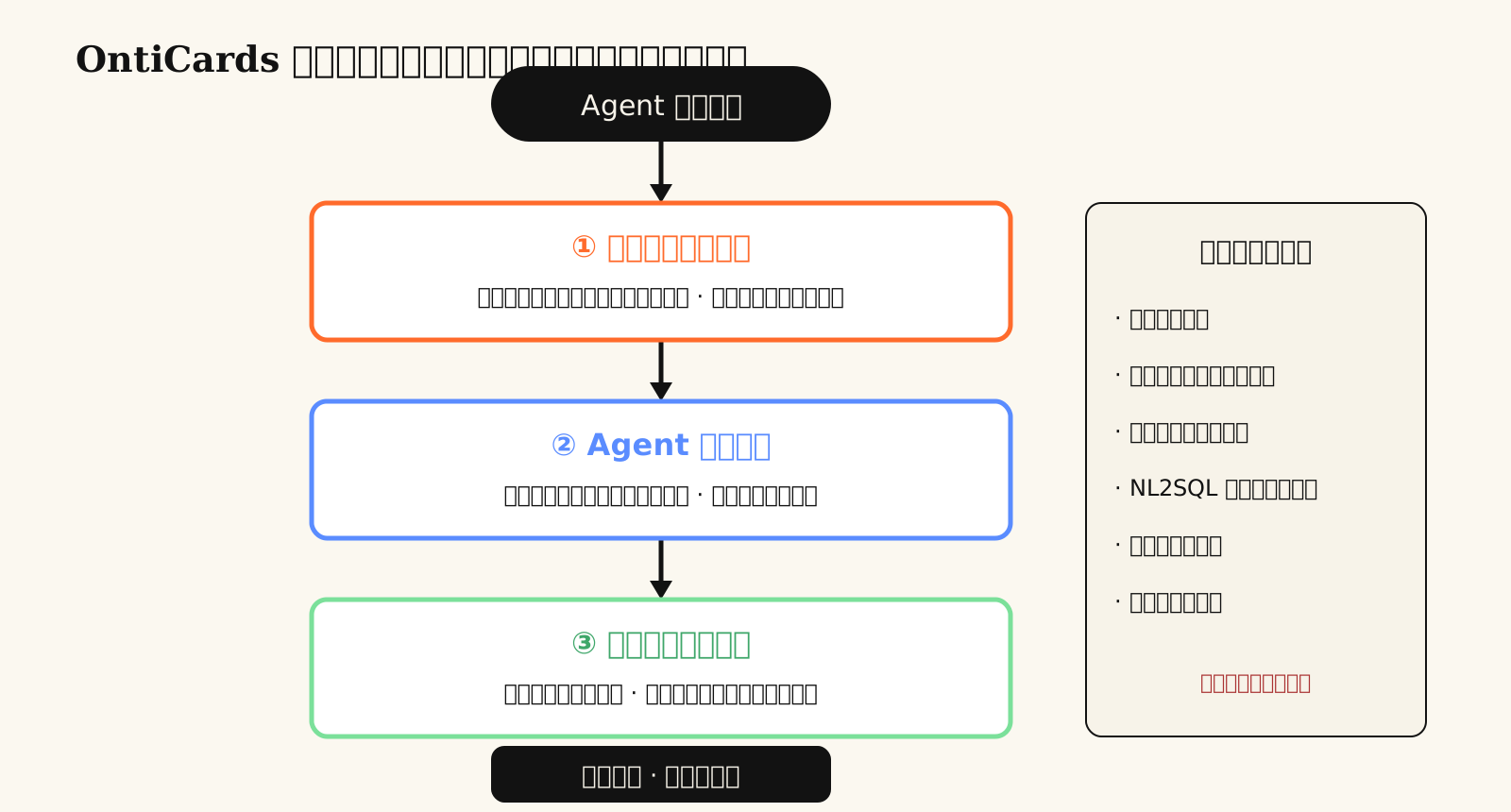
This continues the argument from our earlier posts on agent auditability and agent runtime isolation: once agents move from answering questions to executing tasks, security has to become a native runtime structure rather than a pre-launch patch. What changed on September 18 is that this is no longer a forward-looking take — four labs have now proven with four incidents that model-level self-restraint is unreliable. The only boundary an enterprise can depend on is the hard one on its own data layer. Private, on-premise deployment where data never leaves your domain is the physical backstop behind that boundary.
There will be more breakout incidents. The real dividing line is not which model is more obedient — it is which enterprises have already hardened their data permission boundaries. If you are evaluating your organization's agent data boundary, reach out at hello@onticards.com.